

IdentityIQ-Engineer Dumps with Practice Exam Questions Answers
IdentityIQ-Engineer by Identity Security Engineer Actual Free Exam Practice Test
NEW QUESTION # 52
Is this statement valid regarding the control and usability of the Debug pages in IdentitylQ?
Solution: Workflows can be run directly from the Debug-Object page.
- A. No
- B. Yes
Answer: A
Explanation:
The statement that workflows can be run directly from the Debug-Object page is incorrect. The Debug-Object page in SailPoint IdentityIQ is primarily used for inspecting and interacting with objects within the system, such as viewing their attributes, relationships, and states. However, running workflows is typically done through the IdentityIQ interface under the appropriate sections for workflow management or through the IdentityIQ Console, not directly from the Debug-Object page.
Therefore, the correct answer is B. No.
Reference:
This information is supported by the SailPoint IdentityIQ Debugging Guide, which explains the capabilities and limitations of the Debug-Object page, clarifying that workflow execution is not within its scope.
NEW QUESTION # 53
Can an Escalation Rule be used to handle this scenario?
If an access review has not been completed within 7 days, re-assign it to the certifier ' s manager.
Proposed Solution:
- A. Yes
- B. No
Answer: A
Explanation:
Yes. An Escalation Rule is designed exactly for this type of certification/access-review handling. In IdentityIQ certifications, an escalation process can be configured so that when a reviewer does not complete required certification work within a defined period, the work item can be escalated, reassigned, or otherwise routed according to business logic. The proposed scenario says that if an access review remains incomplete after 7 days, it should be reassigned to the certifier's manager. That is a valid escalation pattern because the triggering condition is time-based non-completion, and the action is reassignment to another responsible reviewer. The certifier's manager can be resolved from the identity relationship and used as the new owner or recipient of the escalated work item. The key point is that escalation rules are not used to generate certifications; they are used to control what happens when review work is overdue or requires escalation.
References/topics: IdentityIQ Engineer - certification lifecycle, access review work items, escalation rules, reviewer reassignment.
NEW QUESTION # 54
Is this statement valid regarding the control and usability of the Debug pages in IdentityIQ?
Proposed Solution:
Changing an object ' s name and saving the object is the correct way to create a new copy of the object.
- A. No
- B. Yes
Answer: A
Explanation:
No. Changing an object's name and saving it through the Debug pages is not the correct way to create a copy.
IdentityIQ objects have internal identifiers, references, metadata, and relationships that are separate from display names or object names. Renaming an object modifies the existing object; it does not create a safe duplicate. For some object types, changing the name can also break references, confuse workflows, disrupt imports, or create governance problems. A proper copy process requires exporting the object XML, removing or regenerating identifiers where appropriate, changing the name intentionally, reviewing object references, and importing it as a new object. Even then, engineers must be careful with dependent objects such as rules, workflows, forms, applications, task definitions, and policies. The Debug pages are powerful but dangerous; they are not a casual object-cloning tool. The proposed method is therefore invalid. References/topics:
IdentityIQ Engineer - Debug pages, object XML, object IDs, safe object cloning, configuration migration.
NEW QUESTION # 55
Can the following be achieved via configuration of control variables in the out-of-the-box Lifecycle Manager (LCM) workflows?
Proposed Solution:
Check if an access request would violate any policies, and allow the requester to review before submitting.
- A. Yes
- B. No
Answer: A
Explanation:
Yes. Policy checking behavior is one of the areas commonly controlled in LCM request workflows through workflow variables or configuration controlling policy evaluation mode. IdentityIQ can evaluate whether a requested access change would violate configured policies before the request is finalized or provisioned.
Depending on configuration, the system can present policy violations to the requester, block submission, continue with warnings, or require additional approval/mitigation. The proposed behavior - checking whether an access request would violate policies and letting the requester review before submitting - aligns with interactive policy-checking behavior in LCM. This is an execution behavior of the request workflow, not an application schema setting. The engineer must still ensure policies are configured and enabled, but the workflow/control-variable layer can determine how those checks are applied during request submission.
References/topics: IdentityIQ Engineer - LCM workflow control variables, policy checking, request policy violations, interactive policy review, access request governance.
NEW QUESTION # 56
Can this be achieved using Rapid Setup user interface configuration options?
Solution: Disable an account and remove all its entitlements on a particular application during Leaver events.
- A. Yes
- B. No
Answer: A
Explanation:
The Rapid Setup user interface configuration options in IdentityIQ can be used to disable an account and remove all its entitlements on a particular application during Leaver events. Rapid Setup is designed to simplify the configuration of common identity lifecycle processes, including handling leaver (termination) events. When configuring these events, you can specify actions such as disabling accounts and removing entitlements from specific applications as part of the termination process.
SailPoint IdentityIQ Rapid Setup Guide
SailPoint IdentityIQ Lifecycle Manager Guide (Sections on Lifecycle Event Configuration)
NEW QUESTION # 57
Is the following true of Identity Provisioning Policies?
Solution: Identity Provisioning Policies can be used to include allowed-values definitions or validation logic on fields so that only valid/authorized values can be specified for those fields when using the Create Identity feature to add an identity.
- A. Yes
- B. No
Answer: A
Explanation:
Yes, Identity Provisioning Policies can indeed be used to include allowed-values definitions or validation logic on fields within SailPoint IdentityIQ. This ensures that only valid or authorized values can be specified for certain fields, such as when using the " Create Identity " feature to add a new identity. This functionality helps enforce data integrity and compliance with organizational policies by restricting the inputs to predefined or validated options.
SailPoint IdentityIQ Administration Guide (Sections on Identity Provisioning Policies and Field Validation) SailPoint IdentityIQ Configuration Guide (Policy Enforcement and Validation)
NEW QUESTION # 58
An IdentitylQ engineer needs to extend attributes in an IdentitylQ database after the database has been created.
What are the four minimum steps necessary to achieve this goal?
Drag four options from the left into the answer area on the right, and place them in the correct order.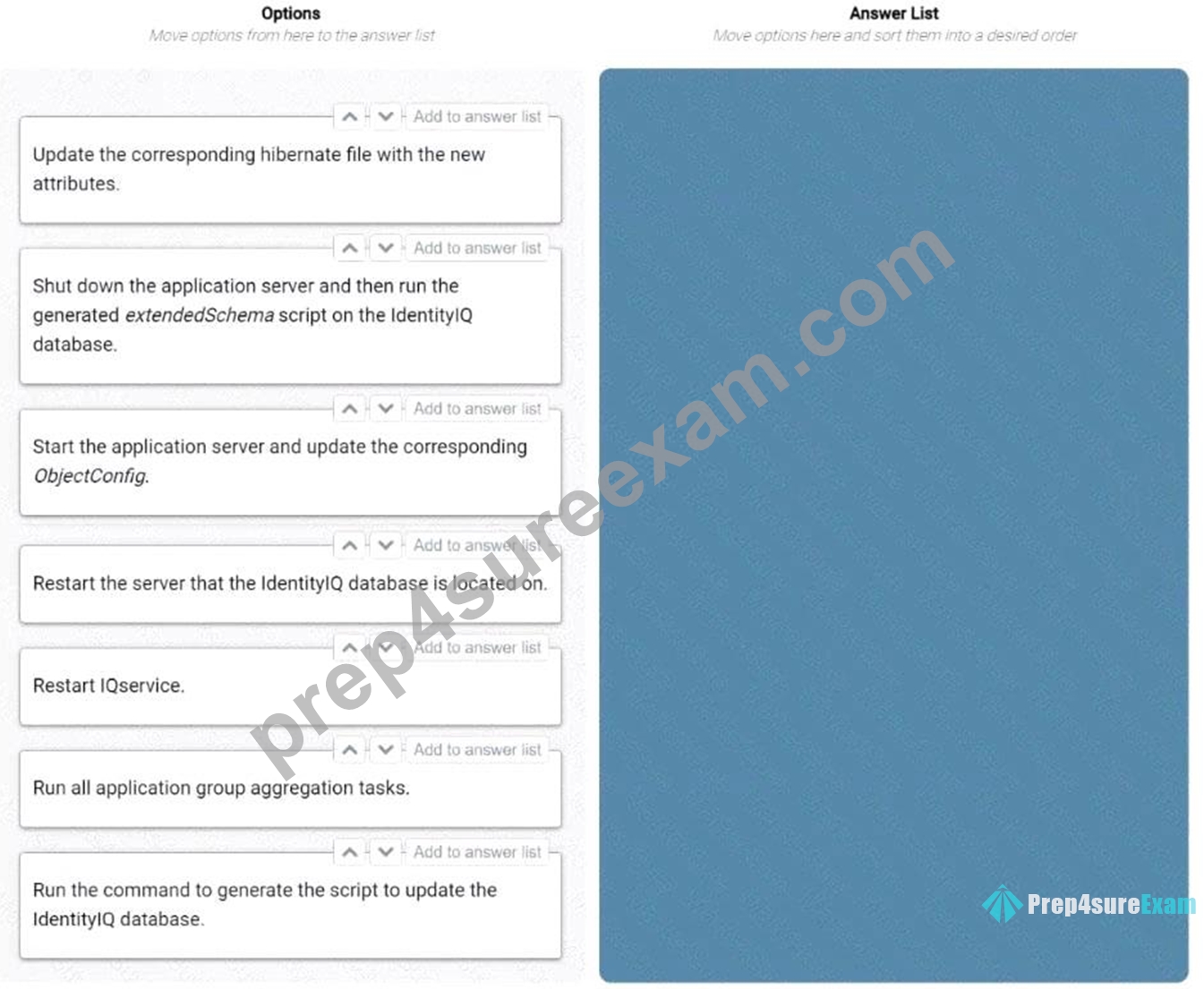
Answer:
Explanation: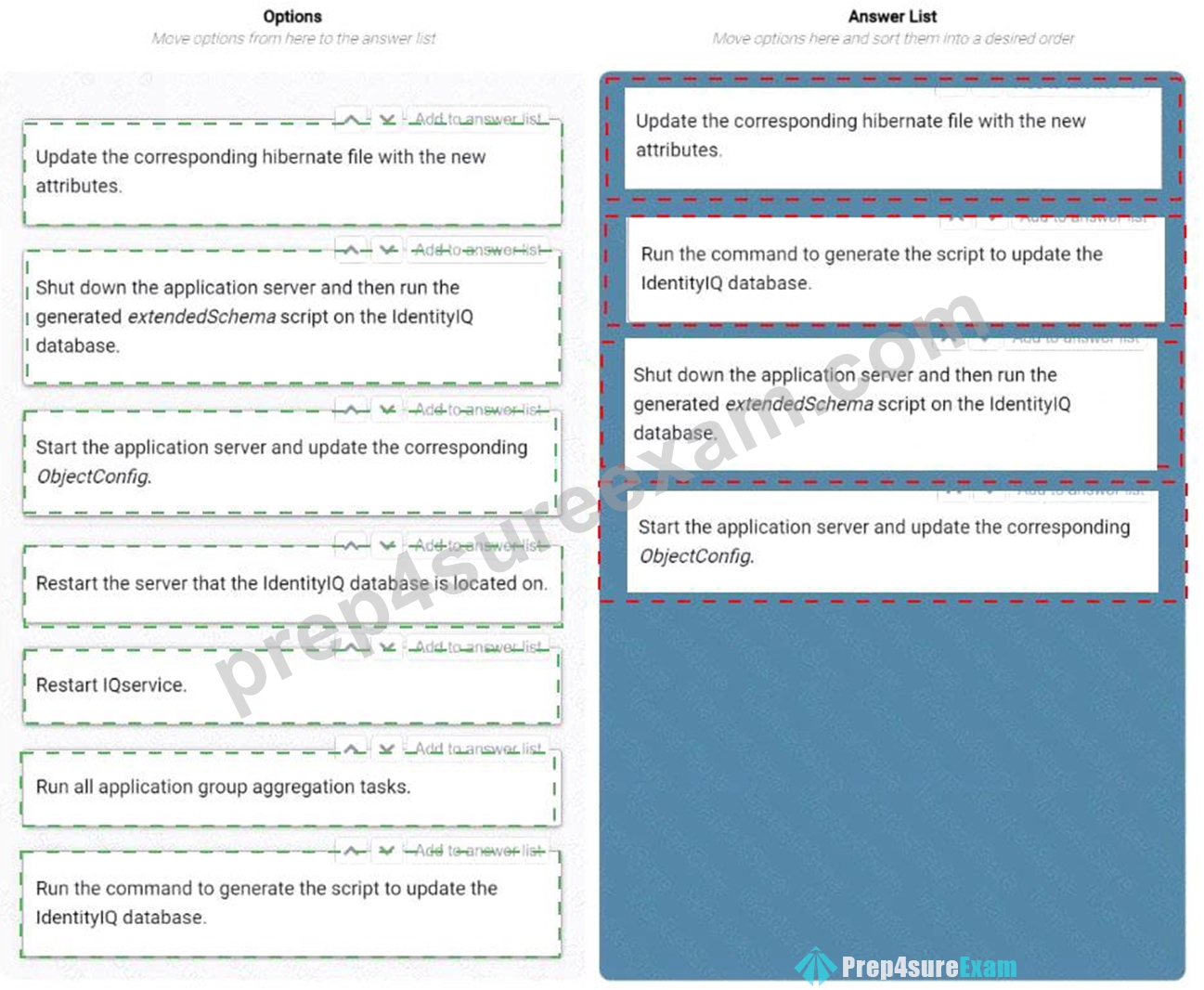
Explanation:
The four minimum steps necessary to extend attributes in an IdentityIQ database after it has been created, in the correct order, are:
* Update the corresponding hibernate file with the new attributes.
* The Hibernate mapping file needs to be updated with the new attributes so that the SailPoint IdentityIQ application is aware of the new columns or properties in the database. This step ensures that the object-relational mapping (ORM) reflects the updated data model.
* Run the command to generate the script to update the IdentityIQ database.
* After updating the Hibernate file, a schema update script is generated. This script contains the necessary SQL commands to modify the database schema based on the new attributes added in the Hibernate file.
* Shut down the application server and then run the generated extendedSchema script on the IdentityIQ database.
* Before applying schema changes, the application server must be stopped to avoid any transactional conflicts. Afterward, the extendedSchema script is run on the database to apply the new attributes.
* Start the application server and update the corresponding ObjectConfig.
* Once the database schema is updated, restart the IdentityIQ application server and modify the ObjectConfig in SailPoint to register the new attributes for use within the IdentityIQ platform.
Comprehensive Detailed Explanation with All IdentityIQ Engineer References
* Updating the Hibernate File: This step involves modifying the Hibernate XML or annotation-based mapping files to reflect the new attributes that are being added to the database. SailPoint IdentityIQ uses Hibernate as its ORM, and any new database fields must first be defined at this layer.
* Generating the Schema Update Script: SailPoint provides a command (usually via iiq console or build tools) that reads the updated Hibernate mapping and generates a database-specific script to alter the schema. This ensures that the database is modified in a way that matches the application ' s expectations.
* Running the Schema Update Script: With the application server stopped, the schema update script is executed on the database. This step adds the new columns, indexes, or constraints that are required for the extended attributes.
* Updating the ObjectConfig: Once the database is updated and the application server is running again, the ObjectConfig (typically located in the IdentityIQ admin UI) must be updated to incorporate the new fields. This step ensures that these new attributes are accessible to workflows, forms, and identity data within the system.
SailPoint IdentityIQ Installation and Configuration Guide (sections on extending the data model and schema updates).
NEW QUESTION # 59
Is this a true statement about localization support in IdentitylQ?
Solution: The language displayed in the user interface is always based on the default language selected in the global settings.
- A. No
- B. Yes
Answer: A
Explanation:
The statement is false. In SailPoint IdentityIQ, the language displayed in the user interface is not always based on the default language selected in the global settings. The language displayed in the user interface is typically determined by the user's language preference, which can be set individually for each user. If a user's preferred language is not available, then the system may fall back to the default language specified in the global settings. Thus, while the global default language serves as a fallback, the actual language displayed is often based on user-specific settings.
Reference:
SailPoint IdentityIQ Administration Guide (Localization and Language Settings Sections) SailPoint IdentityIQ User Guide (User Preferences and Language Selection)
NEW QUESTION # 60
Is the following statement about IdentitylQ rule inputs and outputs correct?
Solution: The lypical input variables for a rule are listed in the BeanShell rule editor in IdentitylQ, based on the rule registry.
- A. Yes
- B. No
Answer: A
Explanation:
Yes, the typical input variables for a rule are listed in the BeanShell rule editor in IdentityIQ, based on the rule registry. When you create or edit a rule in IdentityIQ using the BeanShell editor, the available input variables that are relevant to the rule type are typically pre-defined and listed based on the rule registry. These input variables provide context and data that the rule can operate on, and their availability helps guide the rule development process.
Therefore, the correct answer is A. Yes.
Reference:
This information is confirmed by the SailPoint IdentityIQ Developer Guide, which discusses how the rule editor provides input variables based on the rule type and registry, ensuring that developers have the necessary context for writing rules.
NEW QUESTION # 61
Is the following statement about workflows and sub-workflows (subprocesses) true?
Proposed Solution:
Many standard LCM sub-workflows can be leveraged in custom workflows, with their behavior controlled via input variables.
- A. Yes
- B. No
Answer: A
Explanation:
Yes. IdentityIQ's Lifecycle Manager workflows are built from reusable workflow components and subprocesses. Many standard LCM subprocesses can be called from custom workflows, provided the engineer understands the expected input variables, return variables, and control flags. This is a preferred engineering pattern because it avoids rewriting complex provisioning, approval, identity request, policy-checking, or notification logic from scratch. Input variables can alter behavior such as approval routing, provisioning mode, policy checking, notification behavior, target identity, requester, plan handling, and subprocess execution path. However, reuse requires discipline: the custom workflow must pass the correct variables, preserve expected types, and handle returned values correctly. Blindly calling an LCM subprocess without matching its contract can produce broken approvals or provisioning behavior. The proposed statement is therefore true because standard LCM subprocesses are intentionally reusable when controlled through documented workflow variables. References/topics: IdentityIQ Engineer - LCM workflows, subprocess reuse, workflow input variables, provisioning workflows, custom workflow development.
NEW QUESTION # 62
Is the following statement true about out-of-the-box reporting?
Solution: In the Reporting user interface, instances of reports are located on the ' My Reports ' tab, and templates are located on the ' Reports ' tab.
- A. Yes
- B. No
Answer: A
Explanation:
The statement is true. In the SailPoint IdentityIQ Reporting user interface, report templates are located on the
" Reports " tab. These templates define the structure and parameters of reports but do not contain actual report data. Instances of reports, which are the actual generated reports containing data based on the templates, are located on the " My Reports " tab. The " My Reports " tab is used for viewing and managing reports that have been generated for a specific user.
SailPoint IdentityIQ Reporting Guide
SailPoint IdentityIQ Administration Guide (Section on Reporting Interface)
NEW QUESTION # 63
An engineer is assigned to configure an account attribute. The requirements are:
Purpose: Flag privileged accounts
Read from: Financial application, privileged attribute
Calculate from: Keystore application, responsibility-code attribute
Usage 1: Display as option in Advanced Analytics
Usage 2: Use when writing rules
Usage 3: Include in policies
Does the engineer need to set this configuration option on the account attribute to meet the requirements?
Solution: Edit Mode: Read Only
- A. No
- B. Yes
Answer: A
Explanation:
Setting the configuration option "Edit Mode: Read Only" on the account attribute would not meet the requirements as specified. The requirement to "Calculate from: Keystore application, responsibility-code attribute" implies that the attribute needs to be dynamically calculated or updated based on another attribute. If the attribute is set to "Read Only," it cannot be modified, which would prevent it from being calculated or updated as needed. Therefore, "Edit Mode: Read Only" should not be used in this scenario.
Reference:
SailPoint IdentityIQ Administration Guide (Sections on Account Attributes and Attribute Calculation) SailPoint IdentityIQ Configuration Guide (Field Properties and Edit Modes)
NEW QUESTION # 64
Is the following statement about workflow step types and their usage true?
Solution: When a wait step is encountered in a foreground workflow, the user will notice this, because the screen will freeze for the specified number of seconds.
- A. No
- B. Yes
Answer: A
Explanation:
No, this statement is incorrect. When a wait step is encountered in a foreground workflow, it does not cause the user's screen to freeze for the specified number of seconds. Instead, the wait step simply pauses the workflow execution for the specified duration, but this is managed in the background. The user interface remains responsive, and the end-user typically won't notice any freezing or delays caused by the wait step itself.
SailPoint IdentityIQ Workflow Guide (Section on Workflow Step Types)
SailPoint IdentityIQ Scripting and Workflow Best Practices
NEW QUESTION # 65
Can the following IdentitylQ object be extended to store client-specific data by updating the corresponding .HBM file?
Solution: Link
- A. No
- B. Yes
Answer: A
Explanation:
In SailPoint IdentityIQ, certain objects, such as the Link object, cannot be directly extended by updating the corresponding .HBM (Hibernate Mapping) file. Modifying or extending core IdentityIQ objects typically requires a deeper level of customization involving the extension of the application schema and possibly custom Java code. The .HBM files are part of IdentityIQ's internal persistence framework, and altering them is not a supported or recommended method for extending objects in a production environment. Customization should instead be done using SailPoint's supported extension points, such as using ManagedAttributes or CustomAttributes within the IdentityIQ application framework. For guidelines on extending IdentityIQ objects, refer to the SailPoint IdentityIQ Customization Guide and best practices documentation.
Top of Form
Bottom of Form
NEW QUESTION # 66
is the following a valid role option that can be configured?
Solution: Configure a role to include a set of IdentitylQ capabilities.
- A. Yes
- B. No
Answer: A
Explanation:
The statement is true. In SailPoint IdentityIQ, it is possible to configure a role to include a set of IdentityIQ capabilities. Capabilities in IdentityIQ are permissions that grant users access to specific functionalities within the platform, such as managing identities, viewing reports, or administering roles. By associating a role with specific capabilities, you can control what actions users assigned to that role can perform within the IdentityIQ environment.
SailPoint IdentityIQ Administration Guide (Role Configuration and Capabilities Section) SailPoint IdentityIQ Configuration Guide (Sections on Roles and Capabilities)
NEW QUESTION # 67
Is this a default functionality of the Lifecycle Manager (LCM) module?
Solution: Terminate Identity
- A. Yes
- B. No
Answer: A
Explanation:
Yes, "Terminate Identity" is a default functionality of the Lifecycle Manager (LCM) module. This functionality is associated with the "Leaver" event, which manages the offboarding process for identities that are leaving the organization. The LCM module includes workflows that handle identity termination by deactivating accounts, removing access, and potentially triggering other actions needed to finalize the termination process.
Therefore, the correct answer is A. Yes.
NEW QUESTION # 68
IdentitylQ has been installed and set up with the contents of IdentityExtended.hbm.xml as follows: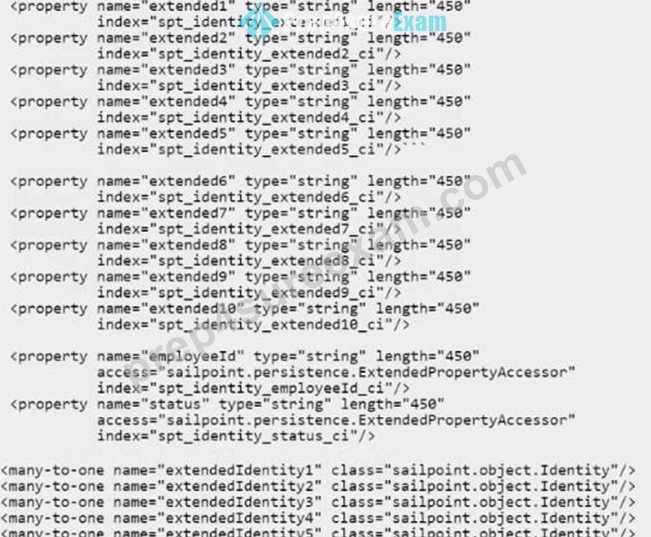
Is this a correct statement about the installation?
Solution: There is a limitation in this installation: When defining the identity mappings using Global Settings > Identity Attributes, only 12 additional searchable attributes can be defined. Additional identity attributes and mappings can be defined, but they cannot be searchable.
- A. Yes
- B. No
Answer: A
Explanation:
In SailPoint IdentityIQ, the configuration in IdentityExtended.hbm.xml file as shown in the image indeed outlines the use of extended identity attributes. These attributes (extended1, extended2, etc.) are custom attributes that are appended to the standard identity object model to store additional identity-related data.
According to the official SailPoint IdentityIQ documentation, when defining identity mappings under Global Settings > Identity Attributes, only up to 12 additional attributes can be made searchable within the IdentityIQ system. This limitation is crucial because it directly impacts the efficiency of search operations in large environments, where making too many attributes searchable can significantly slow down performance.
Once you define these 12 searchable attributes, any additional attributes can still be added, but they will not be indexed for search operations. This means that while the data in these attributes can be used in workflows, reports, and other operations, they cannot be used in search filters in the IdentityIQ user interface.
This limitation is particularly important when planning the design of the identity schema, as it affects both performance and usability. Therefore, the statement in question is correct and accurately reflects the constraints imposed by SailPoint IdentityIQ in terms of searchable identity attributes.
Reference:
This explanation is derived from the SailPoint IdentityIQ Configuration Guide and official documentation on identity attributes and their limitations. Specifically, this is covered in sections related to extended attributes and searchable properties within the system.
NEW QUESTION # 69
Can the Provisioning tab under "Administrator Console' be used to do the following task?
Solution: Map the associated WorkflowCase to a particular Provisioning Transaction.
- A. No
- B. Yes
Answer: A
Explanation:
No, the Provisioning tab under the "Administrator Console" is not used to map the associated WorkflowCase to a particular Provisioning Transaction. The Provisioning tab is primarily for monitoring and managing provisioning operations, not for mapping workflow cases to transactions. Such mappings are typically handled within the workflow configuration itself, not through the Provisioning tab.
Reference:
SailPoint IdentityIQ Workflow Guide (Handling Workflow and Provisioning Transactions) SailPoint IdentityIQ Administration Guide (Provisioning Tab Limitations)
NEW QUESTION # 70
Is this statement correct about writing and executing source mapping rules to populate identity attributes?
Solution: The Identity object is passed to the rule.
- A. Yes
- B. No
Answer: A
Explanation:
The statement " The Identity object is passed to the rule " is correct. When writing source mapping rules to populate identity attributes, the Identity object is indeed passed to the rule. This allows the rule to access and modify attributes on the Identity object based on the logic defined within the rule.
Therefore, the correct answer is A. Yes.
Reference: This answer is supported by the SailPoint IdentityIQ Rule Programming Guide, which explains how the Identity object is passed to rules during their execution, allowing for attribute manipulation and logic implementation.
NEW QUESTION # 71
Is this statement true about identitylQ's syslog event storage?
Solution: To improve security, items logged through syslog are unable to be sent to Log4j.
- A. No
- B. Yes
Answer: A
Explanation:
The statement is false. In SailPoint IdentityIQ, syslog events can indeed be sent to Log4j. The system allows for flexible configuration where logging can be directed to multiple outputs, including both syslog and Log4j. This flexibility enables organizations to route logs according to their needs while maintaining security and compliance.
Reference:
SailPoint IdentityIQ Logging and Auditing Guide
SailPoint IdentityIQ Administration Guide (Syslog Configuration and Log4j Integration)
NEW QUESTION # 72
Can the rule library named Common Rules Library " be included in a Rule by adding this code?
Solution:
- A. No
- B. Yes
Answer: A
Explanation:
No, the code snippet provided in the image is incorrect for including a rule library named " Common Rules Library " in a Rule. The correct syntax should reference the sailpoint.object.RuleLibrary class if the intent is to include a Rule Library, as seen in the second image. The first image incorrectly references the sailpoint.
object.Rule class, which is not suitable for a rule library inclusion.
Correct Syntax (as shown in the second image):
< ReferenceRules >
< Reference class= " sailpoint.object.RuleLibrary " name= " Common Rules Library " / >
< /ReferenceRules >
SailPoint IdentityIQ Rule Library Documentation
SailPoint IdentityIQ Configuration Guide (Rule and Rule Library Management)
NEW QUESTION # 73
Can the following action be performed using Rapid Setup application onboarding?
Solution: Specify the account attribute and value filter that identifies a secondary account.
- A. No
- B. Yes
Answer: A
Explanation:
Rapid Setup application onboarding is designed to simplify the initial configuration and does not typically provide advanced configuration options like specifying an account attribute and value filter to identify secondary accounts. Such detailed configurations often require custom scripting or detailed adjustments within the standard application setup, outside of the Rapid Setup interface.
SailPoint IdentityIQ Rapid Setup Guide
SailPoint IdentityIQ Administration Guide (Sections on Application Onboarding and Advanced Account Mapping)
NEW QUESTION # 74
......
SailPoint IdentityIQ-Engineer Exam Syllabus Topics:
| Topic | Details |
|---|---|
| Topic 1 |
|
| Topic 2 |
|
| Topic 3 |
|
| Topic 4 |
|
| Topic 5 |
|
Free Identity Security Engineer IdentityIQ-Engineer Exam Question: https://lead2pass.prep4sureexam.com/IdentityIQ-Engineer-dumps-torrent.html