

Guaranteed Accomplishment with Newest Apr-2025 FREE SAP C_THR86_2411
Use Valid New Free C_THR86_2411 Exam Dumps & Answers
NEW QUESTION # 46
Your customer uses SAP SuccessFactors Employee Central has the following setup:
*Pay Component (id = "SALARY")
*Pay Component (id = "CARALLOWANCE")
*Pay Component (id = "HOUSEALLOWANCE")
*Pay Component Group (id = "TC") made up of the above three components. The Use for Compa-Ratio Calculation flag is set to Yes for this group.
The customer performs total cash (TC) planning, that is, planners adjust the overall TC. Both the car housing allowances are fixed values based on employee grade. If an employee is promoted on the worksheet, these allowances may change. Salary is whatever TC is left over after the new allowances are updated.
How do you best implement this request while maximizing integration?
- A. Map TC to the standard Current Salary field.
*Use the Merit column for the TC update.
*Publish the finSalary value back to the pay component group in EC have business rules split the sum into the components. - B. Map TC to the standard Current Salary field.
*Use the Merit column for the TC update.
*Use the finSalary field some custom columns to calculate the components publish those back to EC. - C. Map SALARY to the standard Current Salary field TC to meritTarget.
*Use merit to update the TC use custom fields to allow planners to update the allowances.
*Publish each component back separately. - D. Map TC to the standard Current Salary field.
*Use the Merit column for the TC update.
*Extract the new TC with a report manually create import files to update EC.
Answer: A
Explanation:
When a customer uses SAP SuccessFactors Employee Central with specific pay components and a Pay Component Group (PCG) designated for total cash (TC), integration configurations can help manage the pay components based on the planner's adjustments in the compensation module. Here's how the setup can be achieved to maximize integration and minimize manual updates:
* Option B: "Map TC to the standard Current Salary field. Use the Merit column for the TC update.
Publish the finSalary value back to the pay component group in EC and have business rules split the sum into the components."
* By mapping the total cash (TC) to the Current Salary field and using the Merit column for any updates, planners can adjust TC directly. The finSalary field can be configured to reflect the adjusted TC, which can then be published back to Employee Central. Business rules in Employee Central will then split the updated TC value among the components (SALARY, CARALLOWANCE, HOUSEALLOWANCE) based on predefined rules, ensuring that allowances remain consistent with the employee's grade.
NEW QUESTION # 47
What action is required to enable Employee Central integration for a template?
- A. Provide an effective date
- B. Update pay guide format.
- C. Reload guidelines.
- D. Enable field-based permissions.
Answer: A
Explanation:
In SAP SuccessFactors Compensation, enabling integration with Employee Central requires specifying an effective date. This date is essential because Employee Central (EC) integration pulls data that is time- dependent, such as employee job information, pay components, and other relevant details.
* Providing an Effective Date for Integration
* Effective Date: Setting an effective date in the compensation template is necessary to synchronize data accurately from Employee Central. The system uses this date to retrieve the correct employee data as of that specific point in time.
* Why Other Options Are Incorrect
* Option A (field-based permissions) relates to access control but is not specifically required for enabling EC integration.
* Option B (reload guidelines) is used when updating or reloading guideline data but does not affect EC integration.
* Option C (update pay guide format) is unrelated to Employee Central integration.
* Reference Documentation
* SAP SuccessFactors Compensation Guide on Employee Central Integration Setup and Effective Date Configuration.
NEW QUESTION # 48
Which of the following can you use to explore released APIs?
- A. SAP Integration Suite
- B. SAP Business Accelerator Hub
- C. SAP Application Interface Framework
Answer: B
NEW QUESTION # 49
Your customer has implemented SAP SuccessFactors Employee Central (EC) now wishes to implement a single global compensation template. However, only part of the organization is in Employee Central. Some countries are still using SAP ERP, but there are plans to move to SAP SuccessFactors Employee Central over the next two years. The customer wants to use the Compensation module to plan for all employees, regardless of where their employee data sits.
What is the recommended approach to this scenario?
- A. Suggest a phased approach where the non-EC employees become part of the process later as they migrate.
- B. Create a single non-integrated template, export the EC employees, import them via UDF.
- C. Create a single EC-integrated template use the Hybrid Template option.
- D. Create two templates - one with EC integration one without.
Answer: C
NEW QUESTION # 50
You configured merit guidelines as shown in the screenshot.
If an employee has a range penetration of 24% what would be the low to high guideline that would appear in the merit guideline column in the compensation worksheet?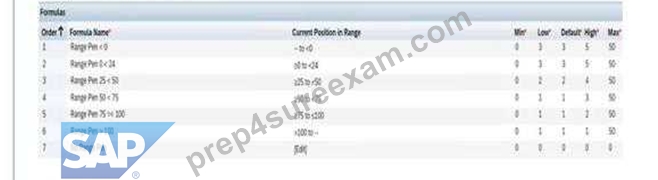
- A. 3%-5%
- B. 2%-4%
- C. 0%-0%
- D. 1%-2%
Answer: B
NEW QUESTION # 51
How can you check for breaks in the Planning Manager Hierarchy?
Note: There are 2 correct answers to this question.
- A. By changing the Method of Planner to Compensation Manager Hierarchy
- B. By using the Check Tool
- C. By using the Rollup Hierarchy report
- D. By exporting troubleshooting information found on the Define Planners screen
Answer: B,D
NEW QUESTION # 52
Your client, who uses SAP SuccessFactors Employee Central, wants to make sure that only employees who have been with the company more than 2 years are eligible for a Lump Sum.
How do you build the eligibility rule to make this happen?
- A. Use the effective date from Job Info to check if the employee has been in this position for more than 2 years.
- B. Add help text to the Lump Sum field to notify planners only to use the field for eligible employees.
- C. Check if the Event Reason is New Hire the effective date is 2 years ago.
- D. Check the Hire Date field to see if the employee started at least 2 years ago.
Answer: D
Explanation:
To configure eligibility based on tenure, you can use the Hire Date field in SAP SuccessFactors to determine how long an employee has been with the company.
* Option B: "Check the Hire Date field to see if the employee started at least 2 years ago."
* By configuring an eligibility rule that references the Hire Date, you can set criteria to check if the employee's start date is at least two years before the form's effective date. This ensures only employees with over two years of tenure are eligible for the Lump Sum.
NEW QUESTION # 53
At the start of the calendar year, all employees are assigned a Performance form. At the end of the year, Salary forms are launched the performance ratings for most employees are displayed correctly, but all new hires are displayed as "N/A". Administrators realize that any employee that joined during the year is missing a Performance form, so they launch a PM form for each new hire.
All new hires are assigned a rating of "Good".
How will these ratings appear on the Salary worksheet?
- A. N/A
- B. Unrated
- C. Too new to rate
- D. Good
Answer: B
NEW QUESTION # 54
Which statements accurately describe Rollup Reports? Note: There are 3 correct answers to this question.
- A. The Rollup Report is based on the current hierarchy not that at form creation.
- B. Custom Columns with the "Show Totals" attribute selected are shown.
- C. Enabling the Rollup Report for End-Users requires a specific tag in the XML.
- D. The Standard, Compensation, Rollup Hierarchies are all supported.
- E. The Rollup Report provides a summary of compensation entries budget information.
Answer: A,C,E
NEW QUESTION # 55
Your customer has a compensation plan template with the functional currency USD. The manager's own currency is EUR. The manager's compensation worksheet contains employees who are paid in the following currencies: EUR, USD, CHF, GBP. Which view must you enable to make sure the manager can display the salary of all of their employees in GBP?
- A. The includeFunctionalCurrency view
- B. The includePlannerCurrency view
- C. The includeLocalCurrency view
- D. The includeAnyCurrency view
Answer: C
NEW QUESTION # 56
Your client wishes to limit new employee salaries so that no employee can exceed 125% compa-ratio. They do not award lump sums.
How can you configure the worksheet to meet this requirement?
Note: There are 2 correct answers to this question.
- A. Create a standard validation of type "splitOrDisallow" action "exceed" with the Threshold at 125.
- B. Create a custom validation of type Error to ensure that the column compaRatio is less than 125.
- C. Create a custom validation of type Error to ensure that the column curRatio is less than 125.
- D. Create a standard validation of type "disallow" action "exceed" with the Threshold at 125.
Answer: B,D
NEW QUESTION # 57
What happens to compensation forms when the currency conversion table is updated during the planning period?
- A. Change is dynamic to in-progress forms.
- B. In-progress forms are only affected when Update All Worksheets is run.
- C. Only completed forms are affected.
- D. In-progress forms are NOT affected.
Answer: A
NEW QUESTION # 58
Which of the following tasks require that worksheets are moved to Complete before they can be performed?
Note: There are 2 correct answers to this question.
- A. Publishing Compensation Results in Employee Central
- B. Generating Compensation Statements
- C. Exporting data from Executive Review
- D. Compensation Plan Activity Audit
Answer: A,B
NEW QUESTION # 59
A customer's salary process has a Final Review step at the end of the route map during which the reward team reviews the recommendations that have been made to ensure budget spend meets limits. The merit guideline is based upon performance rating, compa-ratio, two custom fields, Country Job Family. The customer wishes that the merit increase is reset to the default when the Country changes for an employee, but NOT when the Job Family changes. How can this requirement be met?
- A. Set the Force Default On Custom Column Change option within guidelines to Yes.
- B. Set the Force Default On Rating Change option within guidelines to Yes.
- C. Set the Force Default On Custom Column Change option within guidelines to Yes.
- D. Ensure the default value for all merit guidelines is non-zero.
Answer: A
NEW QUESTION # 60
When generating compensation statements you notice that only the number is appearing for the rating, not the text. How can you correct this?
- A. Add help text to the PM Rating field.
- B. Create a custom column referencing a lookup table to pull in the text.
- C. Change the rating scale in Performance Management.
- D. Update the field-based permissions for the PM Rating field.
Answer: D
NEW QUESTION # 61
What can be configured under Define Standard Validation Rules? Note: There are 2 correct answers to this question.
- A. Split to Lump Sum when exceeding salary range.
- B. Update guideline hard limit.
- C. Disallow save when budget is exceeded.
- D. Force comment when recommendation is outside guidelines.
Answer: A,D
NEW QUESTION # 62
A customer would like percentage fields to only show decimal places if they are available. For example,
40.00% should display as 40%, but if the
Percentage calculation is 40.54%, they want to display the decimal places. What number format should you use?
- A. defPercentFormat ####.####
- B. defPercentFormat #,##0.00
- C. defPercentFormat ###0##
- D. defAmountFormat #,##0##
Answer: C
Explanation:
The defPercentFormat ###0## configuration in SAP SuccessFactors Compensation allows percentages to display decimal points only when necessary.
* Format Explanation
* Format ###0##: This format displays whole numbers without decimal places if the value is an integer (e.g., 40% instead of 40.00%). If there are decimal values present (e.g., 40.54%), it will display them, as it does not limit the number of decimal places but adapts based on the value.
* Why Other Options Are Incorrect
* Option A (#,##0.00) forces two decimal places in all cases.
* Option B (####.####) allows multiple decimal places but would display extra zeros for whole numbers.
* Option C (defAmountFormat #,##0##) is used for amounts, not percentages.
* Reference Documentation
* SAP SuccessFactors Compensation Guide on Percentage and Number Formatting and Field Display Options.
NEW QUESTION # 63
Your customer has the following requirements for their compensation plan:
1.Allow planners to make recommendations outside of the high/low values. 2. Display only the max min values in the compensation worksheet. Which guideline rule settings must you set to fulfill these requirements?
- A. In Display Settings use min-max
*Hard Limit: No
*High/Low Action: Warn - B. In Display Settings use min-max
*Hard Limit: No
*High/Low Action: Allow - C. In Display Settings use min-max
*Hard Limit: Yes
*High/Low Action: Allow - D. In Display Settings use low-high
*Hard Limit: Yes
*High/Low Action: Allow
Answer: B
Explanation:
To allow planners to make recommendations outside of the high/low values but only display max and min values on the worksheet:
* Option A: "In Display Settings use min-max, Hard Limit: No, High/Low Action: Allow"
* Min-max display shows only the minimum and maximum guideline values. Setting Hard Limit to "No" allows planners to make recommendations outside these values, and High/Low Action:
Allow enables the flexibility needed by the client.
NEW QUESTION # 64
Which actions are controlled by role-based permissions? Note: There are 2 correct answers to this question.
- A. Updating a Compensation Statement
- B. Editing columns on a worksheet
- C. Making changes through Executive Review
- D. Opening compensation worksheets
Answer: A,C
NEW QUESTION # 65
Your client is using Salary Proration importing the Proration percentage rather than using Start End Dates. An employee is imported with a 50% proration. The merit guideline table for this employee would normally be 4-
6%.
The planner enters a $1,000 merit increase, which is within the displayed guidelines. Which of the following scenarios is accurate?
- A. Guideline is displayed as 2-3%
*Total Increase is $500 - B. Guideline is displayed as 2-3%
*Total Increase is $1,000 - C. Guideline is displayed as 4-6%
*Total Increase is $1,000 - D. Guideline is displayed as 4-6%
*Total Increase is $500
Answer: A
Explanation:
When Salary Proration is used with a proration percentage (50% in this case) rather than dates, it affects both the guideline range and the total increase.
* Proration Impact on Guideline Range and Total Increase
* Guideline Adjustment: Since the proration is set to 50%, the guideline range (normally 4-6%) is adjusted by 50%, resulting in a prorated guideline of 2-3%.
* Total Increase Calculation: When the planner enters a $1,000 merit increase, the proration factor is applied, resulting in a final increase of $500 (50% of $1,000).
* Why Other Options Are Incorrect
* Options A and B show the original guideline (4-6%), which does not reflect the proration adjustment.
* Option D incorrectly calculates the total increase without applying the 50% proration.
* Reference Documentation
* SAP SuccessFactors Compensation Guide on Salary Proration and Merit Guidelines.
NEW QUESTION # 66
Which of the following are features of the clean core dashboard? Note: There are 2 correct answers to this question.
- A. It can be accessed by using SAP For Me.
- B. Customers can use the dashboard in the dev, test, production tenants.
- C. It can be used in all SAP S/4HANA Cloud editions.
- D. Customers can grant access to the dashboard to partners.
Answer: A,D
NEW QUESTION # 67
Your customer uses a look-up table to calculate custom budgets, as shown in the screenshot. The budget is based on an employee's country status. In the template, the country is defined with field ID customCountry the status is defined with field ID customStatus.
What is the correct syntax to calculate the adjustment budget?
- A. toNumber(lookup("2018_BudgetPool", custom Country.customStatus,2))"'curSalary
- B. toNumber(lookup("2018_BudgetPool", custom Country,customStatus,adjustment))"curSalary
- C. toNumber(lookup("2018_BudgetPool", custom Country,customStatus,1))"'curSalary
- D. toNumber(lookup("2018_BudgetPool,custom Country, customStatus, Adjustment))*curSalary
Answer: C
NEW QUESTION # 68
You set up a merit guideline rule based on the performance rating country. You configure guideline formulas as shown in the screenshot.
An employee in the US has a rating of 3. What will be their default merit increase?
- A. 4%
- B. 2%
- C. 1%
- D. 0%
Answer: B
NEW QUESTION # 69
......
C_THR86_2411 Braindumps PDF, SAP C_THR86_2411 Exam Cram: https://lead2pass.prep4sureexam.com/C_THR86_2411-dumps-torrent.html