

Course 2024 CCST-Networking Test Prep Training Practice Exam Download
CCST-Networking Exam Info and Free Practice Test Professional Quiz Study Materials
Cisco CCST-Networking Exam Syllabus Topics:
| Topic | Details |
|---|---|
| Topic 1 |
|
| Topic 2 |
|
| Topic 3 |
|
| Topic 4 |
|
NEW QUESTION # 17
Which component of the AAA service security model provides identity verification?
- A. Authentication
- B. Authorization
- C. Accounting
- D. Auditing
Answer: A
Explanation:
The AAA service security model consists of three components: Authentication, Authorization, and Accounting.
*Authentication: This is the process of verifying the identity of a user or device. It ensures that only legitimate users can access the network or service.
*Authorization: This determines what an authenticated user is allowed to do or access within the network.
*Auditing/Accounting: This component tracks the actions of the user, including what resources they access and what changes they make.
Thus, the correct answer is C. Authentication.
References :=
*Cisco AAA Overview
*Understanding AAA (Authentication, Authorization, and Accounting)
NEW QUESTION # 18
For each statement about bandwidth and throughput, select True or False.
Note: You will receive partial credit for each correct selection.
Answer:
Explanation:
Explanation:
* Statement 1: Low bandwidth can increase network latency.
* True: Low bandwidth can result in increased network latency because the network may become congested, leading to delays in data transmission.
* Statement 2: High levels of network latency decrease network bandwidth.
* False: High levels of network latency do not decrease the available network bandwidth, but they do affect the perceived performance and throughput of the network.
* Statement 3: You can increase throughput by decreasing network latency.
* True: Decreasing network latency can increase throughput because data can be transmitted more quickly and efficiently without delays.
* Bandwidth vs. Latency: Bandwidth refers to the maximum rate at which data can be transferred over a network path. Latency is the time it takes for a data packet to travel from the source to the destination.
* Low bandwidth can cause network congestion, which can increase latency as packets wait to be transmitted.
* High latency does not reduce the actual bandwidth but can affect the overall performance and efficiency of data transmission.
* Reducing latency can lead to higher throughput because the network can handle more data in a given period without delays.
References:
* Network Performance Metrics: Cisco Network Performance
* Understanding Bandwidth and Latency: Bandwidth vs. Latency
NEW QUESTION # 19
A Cisco PoE switch is shown in the following image. Which type of port will provide both data connectivity and power to an IP phone?
- A. Ports identified with numbers 3 and 4
- B. Ports identified with number 6
- C. Ports identified with number 7
- D. Port identified with number 2
Answer: B
Explanation:
In the provided image of the Cisco PoE switch, the ports identified with number 6 are the standard RJ-45 Ethernet ports typically found on switches that provide both data connectivity and Power over Ethernet (PoE).
PoE ports are designed to supply power to devices such as IP phones, wireless access points, and other PoE-enabled devices directly through the Ethernet cable.
Ports:
*2: Console port (for management and configuration)
*3 and 4: Specific function ports (often for management)
*6: RJ-45 Ethernet ports (capable of providing PoE)
*7: SFP ports (for fiber connections, typically do not provide PoE)
Thus, the correct answer is C. Ports identified with number 6.
References :=
*Cisco Catalyst 2960-L Series Switches Data Sheet
*Cisco PoE Overview
NEW QUESTION # 20
Move the security options from the list on the left to its characteristic on the right. You may use each security option once, more than once, or not at all.
Note: You will receive partial credit for each correct answer.
Answer:
Explanation:
Explanation:
The correct matching of the security options to their characteristics is as follows:
* WPA2-Enterprise: Uses a RADIUS server for authentication
* WEP: Uses a minimum of 40 bits for encryption
* WPA2-Personal: Uses AES and a pre-shared key for authentication
Here's why each security option matches the characteristic:
* WPA2-Enterpriseuses a RADIUS server for authentication, which provides centralized Authentication, Authorization, and Accounting (AAA) management for users who connect and use a network service.
* WEP (Wired Equivalent Privacy)is an outdated security protocol that uses a minimum of 40 bits for encryption (and up to 104 bits), which is relatively weak by today's standards.
* WPA2-Personal(Wi-Fi Protected Access 2 - Personal) uses the Advanced Encryption Standard (AES) for encryption and a pre-shared key (PSK) for authentication, which is shared among users to access the network.
These security options are essential for protecting wireless networks from unauthorized access and ensuring data privacy.
NEW QUESTION # 21
Examine the connections shown in the following image. Move the cable types on the right to the appropriate connection description on the left. You may use each cable type more than once or not at all.
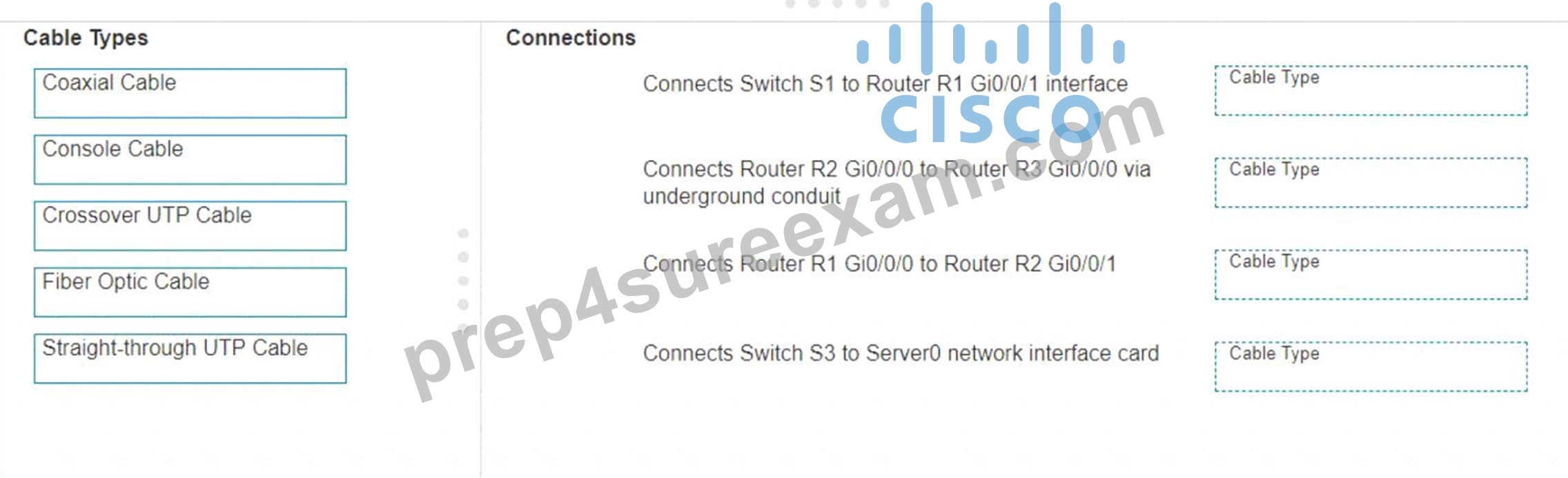
Answer:
Explanation:
Explanation:
Based on the image description provided, here are the cable types matched with the appropriate connection descriptions:
Connects Switch S1 to Router R1 Gi0/0/1 interfaceCable Type: = Straight-through UTP Cable Connects Router R2 Gi0/0/0 to Router R3 Gi0/0/0 via underground conduitCable Type: = Fiber Optic Cable Connects Router R1 Gi0/0/0 to Router R2 Gi0/0/1Cable Type: = Crossover UTP Cable Connects Switch S3 to Server0 network interface cardCable Type: = Straight-through UTP Cable The choices are based on standard networking practices where:
* Straight-through UTP cablesare typically used to connect a switch to a router or a network interface card.
* Fiber optic cablesare ideal for long-distance, high-speed data transmission, such as connections through an underground conduit.
* Crossover UTP cablesare used to connect similar devices, such as router-to-router connections.
These matches are consistent with the color-coded cables in the image: green for switch connections, yellow for router-to-router connections within the same rack, and blue for inter-rack connections. The use of these cables follows the Ethernet cabling standards.
* Connects Switch S1 to Router R1 Gi0/0/1 interface:
* Cable Type: Straight-through UTP Cable
* Explanation: A straight-through UTP cable is typically used to connect different types of devices, such as a switch to a router.
* Connects Router R2 Gi0/0/0 to Router R3 Gi0/0/0 via underground conduit:
* Cable Type: Fiber Optic Cable
* Explanation: Fiber optic cables are used for long-distance connections, such as those through an underground conduit between buildings.
* Connects Router R1 Gi0/0/0 to Router R2 Gi0/0/1:
* Cable Type: Crossover UTP Cable
* Explanation: A crossover UTP cable is typically used to connect similar devices directly, such as router to router connections.
* Connects Switch S3 to Server0 network interface card:
* Cable Type: Straight-through UTP Cable
* Explanation: A straight-through UTP cable is typically used to connect a switch to an end device, such as a server.
* Straight-through UTP Cable: Used to connect different devices (e.g., switch to router, switch to server).
* Crossover UTP Cable: Used to connect similar devices directly (e.g., router to router, switch to switch).
* Fiber Optic Cable: Used for long-distance and high-speed connections, often between buildings or data centers.
References:
* Network Cable Types and Uses: Cisco Network Cables
* Understanding Ethernet Cabling: Ethernet Cable Guide
NEW QUESTION # 22
You want to list the IPv4 addresses associated with the host name www.companypro.net.
Complete the command by selecting the correct option from each drop-down list.
Answer:
Explanation:
Explanation:
To list the IPv4 addresses associated with the host name www.companypro.net, you should use the following command:
nslookup www.companypro.net
This command will query the DNS servers to find the IP address associated with the hostname provided.If you want to ensure that it returns the IPv4 address, you can specify the-type=Aoption, which stands for Address records that hold IPv4 addresses1. However, thenslookupcommand by default should return the IPv4 address if available.
To list the IPv4 addresses associated with the host namewww.companypro.net, you should use thenslookup command.
* Command: nslookup
* Target:www.companypro.net
So, the completed command is:
* nslookupwww.companypro.net
* nslookup: This command is used to query the Domain Name System (DNS) to obtain domain name or IP address mapping or for any other specific DNS record.
* www.companypro.net: This is the domain name you want to query to obtain its associated IP addresses.
References:
* Using nslookup: nslookup Command Guide
NEW QUESTION # 23
Move each protocol from the list on the left to the correct TCP/IP model layer on the right.
Note: You will receive partial credit for each correct match.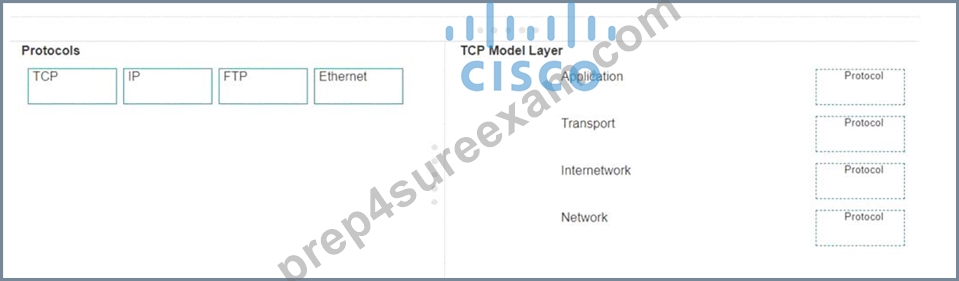
Answer:
Explanation:
Explanation:
Here's how each protocol aligns with the correct TCP/IP model layer:
* TCP (Transmission Control Protocol): This protocol belongs to theTransportlayer, which is responsible for providing communication between applications on different hosts1.
* IP (Internet Protocol): IP is part of theInternetworklayer, which is tasked with routing packets across network boundaries to their destination1.
* FTP (File Transfer Protocol): FTP operates at theApplicationlayer, which supports application and end-user processes.It is used for transferring files over the network1.
* Ethernet: While not a protocol within the TCP/IP stack, Ethernet is associated with theNetwork Interfacelayer, which corresponds to the link layer of the TCP/IP model and is responsible for the physical transmission of data1.
The TCP/IP model layers are designed to work collaboratively to transmit data from one layer to another, with each layer having specific protocols that perform functions necessary for the data transmission process1.
* TCP:
* TCP Model Layer: Transport
* Explanation: The Transport layer is responsible for end-to-end communication and error handling. TCP (Transmission Control Protocol) operates at this layer to provide reliable, ordered, and error-checked delivery of data.
* IP:
* TCP Model Layer: Internetwork
* Explanation: The Internetwork layer, also known as the Internet layer, is responsible for logical addressing and routing. IP (Internet Protocol) operates at this layer to route packets across networks.
* FTP:
* TCP Model Layer: Application
* Explanation: The Application layer provides network services to applications. FTP (File Transfer Protocol) operates at this layer to transfer files between computers over a network.
* Ethernet:
* TCP Model Layer: Network
* Explanation: The Network layer, also known as the Link layer in the TCP/IP model, is responsible for physical addressing and access to the physical medium. Ethernet operates at this layer to provide the physical and data link functions.
* Transport Layer: This layer is responsible for providing communication services directly to the application processes running on different hosts. TCP is a core protocol in this layer.
* Internetwork Layer: This layer is responsible for logical addressing, routing, and packet forwarding.
IP is the primary protocol for this layer.
* Application Layer: This layer interfaces directly with application processes and provides common network services. FTP is an example of a protocol operating in this layer.
* Network Layer: In the TCP/IP model, this layer includes both the data link and physical layers of the OSI model. Ethernet is a protocol used in this layer to define network standards and communication protocols at the data link and physical levels.
References:
* TCP/IP Model Overview: Cisco TCP/IP Model
* Understanding the TCP/IP Model: TCP/IP Layers
NEW QUESTION # 24
A local company requires two networks in two new buildings. The addresses used in these networksmust be in the private network range.
Which two address ranges should the company use? (Choose 2.)
Note: You will receive partial credit for each correct selection.
- A. 192.16.0.0 to 192.16.255.255
- B. 11.0.0.0 to 11.255.255.255
- C. 172.16.0.0 to 172.31.255.255
- D. 192.168.0.0 to 192.168.255.255
Answer: C,D
Explanation:
The private IP address ranges that are set aside specifically for use within private networks and not routable on the internet are as follows:
* Class A: 10.0.0.0 to 10.255.255.255
* Class B: 172.16.0.0 to 172.31.255.255
* Class C: 192.168.0.0 to 192.168.255.255
These ranges are defined by the Internet Assigned Numbers Authority (IANA) and are used for local communications within a private network123.
Given the options: A.172.16.0.0 to 172.31.255.255falls within the Class B private range. B.192.16.0.0 to
192.16.255.255is not a recognized private IP range. C.11.0.0.0 to 11.255.255.255is not a recognized private IP range. D.192.168.0.0 to 192.168.255.255falls within the Class C private range.
Therefore, the correct selections that the company should use for their private networks areAandD.
References:=
* Reserved IP addresses on Wikipedia
* Private IP Addresses in Networking - GeeksforGeeks
* Understanding Private IP Ranges, Uses, Benefits, and Warnings
NEW QUESTION # 25
Which wireless security option uses a pre-shared key to authenticate clients?
- A. WPA2-Enterprise
- B. 802.1q
- C. WPA2-Personal
- D. 802.1x
Answer: C
Explanation:
WPA2-Personal, also known as WPA2-PSK (Pre-Shared Key), is the wireless security option that uses a pre-shared key to authenticate clients. This method is designed for home and small office networks and doesn't require an authentication server. Instead, every user on the network uses the same key or passphrase to connect1.
References :=
*What is a Wi-Fi Protected Access Pre-Shared Key (WPA-PSK)?
*Exploring WPA-PSK and WiFi Security
*WPA2-Personal: This wireless security option uses a pre-shared key (PSK) for authentication. Each client that connects to the network must use this key to gain access. It is designed for home and small office networks where simplicity and ease of use are important.
*WPA2-Enterprise: Unlike WPA2-Personal, WPA2-Enterprise uses 802.1x authentication with an authentication server (such as RADIUS) and does not rely on a pre-shared key.
*802.1x: This is a network access control protocol for LANs, particularly wireless LANs. It provides an authentication mechanism to devices wishing to attach to a LAN or WLAN.
*802.1q: This is a networking standard that supports VLAN tagging on Ethernet networks and is not related to wireless security.
References:
*Cisco Documentation on WPA2 Security: Cisco WPA2
*Understanding Wireless Security: Wireless Security Guide
NEW QUESTION # 26
Which device protects the network by permitting or denying traffic based on IP address, port number, or application?
- A. VPN gateway
- B. Intrusion detection system
- C. Access point
- D. Firewall
Answer: D
Explanation:
* Firewall: A firewall is a network security device that monitors and controls incoming and outgoing network traffic based on predetermined security rules. It permits or denies traffic based on IP addresses, port numbers, or applications.
* Access Point: This is a device that allows wireless devices to connect to a wired network using Wi-Fi. It does not perform traffic filtering based on IP, port, or application.
* VPN Gateway: This device allows for secure connections between networks over the internet, but it is not primarily used for traffic filtering based on IP, port, or application.
* Intrusion Detection System (IDS): This device monitors network traffic for suspicious activity and policy violations, but it does not actively permit or deny traffic.
References:
* Understanding Firewalls: Firewall Basics
NEW QUESTION # 27
Examine the following output:
Which two conclusions can you make from the output of the tracert command? (Choose 2.) Note: You will receive partial credit for each correct answer.
- A. The IPv6 address associated with the www.cisco.com server is 2600:1408: c400: 38d: : b33.
- B. The trace successfully reached the www.cisco.com server.
- C. The trace failed after the fourth hop.
- D. The routers at hops 5 and 6 are offline.
- E. The device sending the trace has IPv6 address 2600:1408:c400:38d :: b33.
Answer: A,B
Explanation:
*Statement A: "The trace successfully reached the www.cisco.com server." This is true as indicated by the
"Trace complete" message at the end, showing that the trace has reached its destination.
*Statement C: "The IPv6 address associated with the www.cisco.com server is 2600:1408:c400:38d::b33." This is true because the final hop in the trace, which is the destination, has this IPv6 address.
*Statement B: "The trace failed after the fourth hop." This is incorrect as the trace continues beyond the fourth hop, despite some intermediate timeouts.
*Statement D: "The routers at hops 5 and 6 are offline." This is not necessarily true. The routers might be configured to not respond to traceroute requests.
*Statement E: "The device sending the trace has IPv6 address 2600:1408:c400:38d::b33." This is incorrect; this address belongs to the destination server, not the sender.
References:
*Understanding Traceroute: Traceroute Guide
NEW QUESTION # 28
A user reports that a company website is not available. The help desk technician issues a tracert command to determine if the server hosting the website isreachable over the network. The output of the command is shown as follows:
What can you tell from the command output?
- A. The server with the address 192.168.1.10 is reachable over the network.
- B. The router at hop 3 is not forwarding packets to the IP address 192.168.1.10.
- C. Requests to the web server at 192.168.1.10 are being delayed and time out.
- D. The server address 192.168.1.10 is being blocked by a firewall on the router at hop 3.
Answer: A
Explanation:
The tracert command output shows the path taken to reach the destination IP address, 192.168.1.10. The command output indicates:
*Hops 1 and 2 are successfully reached.
*Hop 3 times out, meaning the router at hop 3 did not respond to the tracert request. However, this does not necessarily indicate a problem with forwarding packets, as some routers may be configured to block or not respond to ICMP requests.
*Hops 4 and 5 are successfully reached, with hop 5 being the destination IP 192.168.1.10, indicating that the server is reachable.
Thus, the correct answer is C. The server with the address 192.168.1.10 is reachable over the network.
References :=
*Cisco Traceroute Command
*Understanding Traceroute
The tracert command output indicates that the server with the address 192.168.1.10 is reachable over the network. The asterisk (*) at hop 3 suggests that the probe sent to that hop did not return a response, which could be due to a variety of reasons such as a firewall blocking ICMP packets or the router at that hop being configured not to respond to ICMP requests. However, since the subsequent hops (4 and 5) are showing response times, it means that the packets are indeed getting through and the server is reachable12.
References :=
*How to Use Traceroute Command to Read Its Results
*How to Use the Tracert Command in Windows
NEW QUESTION # 29
Which command will display all the current operational settings configured on a Cisco router?
- A. show startup-config
- B. show protocols
- C. show running-config
- D. show version
Answer: C
Explanation:
Router
Theshow running-configcommand is used on a Cisco router to display the current operational settings that are actively configured in the router's RAM. This command outputs all the configurations that are currently being executed by the router, which includes interface configurations, routing protocols, access lists, and other settings. Unlikeshow startup-config, which shows the saved configuration that the router will use on the next reboot,show running-configreflects the live, current configuration in use.
References:= The information is supported by multiple sources that detail the use of Cisco commands, particularly theshow running-configcommand as the standard for viewing the active configuration on a Cisco device123.
* show running-config: This command displays the current configuration running on the router. It includes all the operational settings and configurations applied to the router.
* show protocols: This command shows the status of configured protocols on the router but not the entire configuration.
* show startup-config: This command displays the configuration saved in NVRAM, which is used to initialize the router on startup, but not necessarily the current running configuration.
* show version: This command provides information about the router's software version, hardware components, and uptime but does not display the running configuration.
References:
* Cisco IOS Commands: Cisco IOS Commands
NEW QUESTION # 30
Which two pieces of information should you include when you initially create a support ticket? (Choose 2.)
- A. The description of the top-down fault-finding procedure
- B. Details about the computers connected to the network
- C. The actions taken to resolve the fault
- D. A description of the conditions when the fault occurs
- E. A detailed description of the fault
Answer: D,E
Explanation:
* Statement A: "A detailed description of the fault." This is essential for support staff to understand the nature of the problem and begin troubleshooting effectively.
* Statement C: "A description of the conditions when the fault occurs." This helps in reproducing the issue and identifying patterns that might indicate the cause of the fault.
* Statement B: "Details about the computers connected to the network." While useful, this is not as immediately critical as understanding the fault itself and the conditions under which it occurs.
* Statement D: "The actions taken to resolve the fault." This is important but typically follows the initial report.
* Statement E: "The description of the top-down fault-finding procedure." This is more of a troubleshooting methodology than information typically included in an initial support ticket.
References:
* Best Practices for Submitting Support Tickets: Support Ticket Guidelines
NEW QUESTION # 31
Move each cloud computing service model from the list on the left to the correct example on the right Note: You will receive partial credit for each correct answer.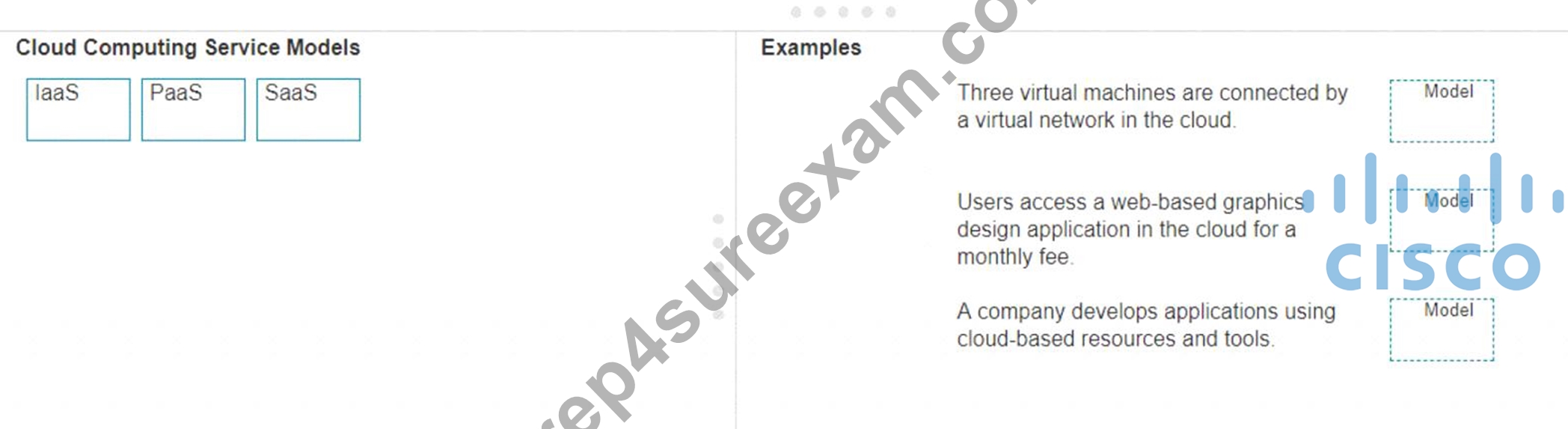
Answer:
Explanation:
Explanation:
* Three virtual machines are connected by a virtual network in the cloud.
* Model: IaaS (Infrastructure as a Service)
* Explanation: IaaS provides virtualized computing resources over the internet, including virtual machines, storage, and networks.
* Users access a web-based graphics design application in the cloud for a monthly fee.
* Model: SaaS (Software as a Service)
* Explanation: SaaS delivers software applications over the internet, typically on a subscription basis, accessible via a web browser.
* A company develops applications using cloud-based resources and tools.
* Model: PaaS (Platform as a Service)
* Explanation: PaaS provides a platform allowing customers to develop, run, and manage applications without dealing with the infrastructure.
* IaaS (Infrastructure as a Service): Provides virtualized hardware resources that customers can use to build their own computing environments.
* PaaS (Platform as a Service): Offers a platform with tools and services to develop, test, and deploy applications.
* SaaS (Software as a Service): Delivers fully functional applications over the internet that users can access and use without managing the underlying infrastructure.
References:
* Cloud Service Models: Understanding IaaS, PaaS, SaaS
* NIST Definition of Cloud Computing:NIST Cloud Computing
NEW QUESTION # 32
Computers in a small office are unable to access companypro.net. You run the ipconfig command on one of the computers. The results are shown in the exhibit.
You need to determine if you can reach the router.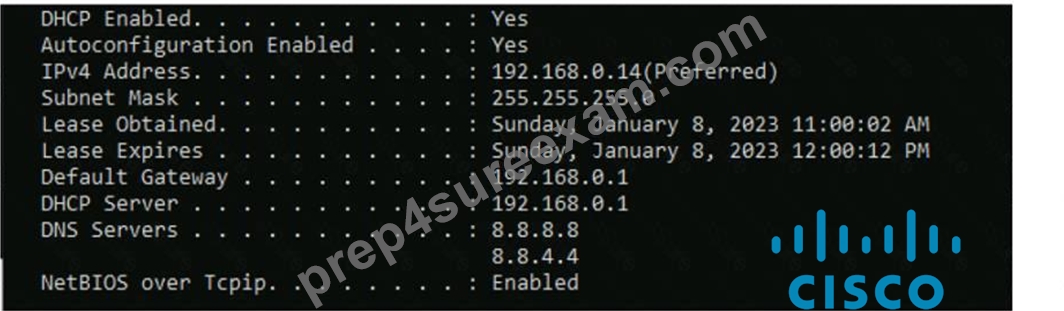
Which command should you use? Complete the command by selecting the correct options from each drop-down lists.
Answer:
Explanation: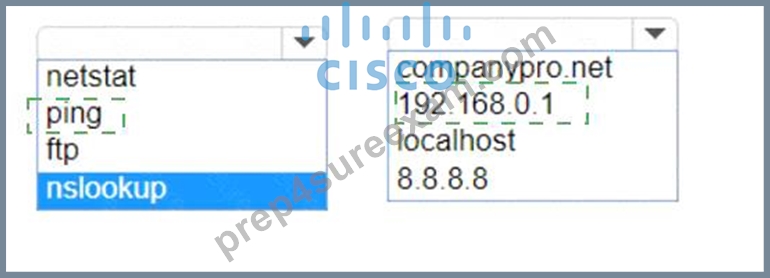
Explanation:
To determine if you can reach the router, you should use thepingcommand followed by the IP address of the router. Thepingcommand is a network utility used to test the reachability of a host on an Internet Protocol (IP) network and to measure the round-trip time for messages sent from the originating host to a destination computer.
The Default Gateway in theipconfigresults is typically the router's IP address in a home or small office network. In this case, the Default Gateway is192.168.0.1, which is the address you would ping to check connectivity to the router.
References:=
* How to Use the Ping Command
* Testing Network Connectivity with the Ping Command
To determine if you can reach the router, you should use thepingcommand with the IP address of the router.
* Command:ping
* Target:192.168.0.1
So, the completed command is:
* ping 192.168.0.1
Step by Step Comprehensive and Detailed Explanation:
* ping: The ping command sends ICMP Echo Request messages to the target IP address and waits for an Echo Reply. It is commonly used to test the reachability of a network device.
* 192.168.0.1: This is the IP address of the default gateway (the router) as shown in theipconfigoutput.
Pinging this address will help determine if the computer can communicate with the router.
References:
* Using the ping Command: ping Command Guide
NEW QUESTION # 33
A help desk technician receives the four trouble tickets listed below. Which ticket should receive the highest priority and be addressed first?
- A. Ticket 2: An online webinar is taking place in the conference room. The video conferencing equipment lost internet access.
- B. Ticket 3: A user reports that response time for a cloud-based application is slower than usual.
- C. Ticket 4: Two users report that wireless access in the cafeteria has been down for the last hour.
- D. Ticket 1: A user requests relocation of a printer to a different network jack in the same office. The jack must be patched and made active.
Answer: A
Explanation:
When prioritizing trouble tickets, the most critical issues affecting business operations or high-impact activities should be addressed first. Here's a breakdown of the tickets:
* Ticket 1: Relocation of a printer, while necessary, is not urgent and does not impact critical operations.
* Ticket 2: An ongoing webinar losing internet access is critical, especially if the webinar is time-sensitive and involves multiple participants.
* Ticket 3: Slower response time for a cloud-based application is important but typically not as urgent as a complete loss of internet access for a live event.
* Ticket 4: Wireless access down in the cafeteria affects users but does not have the same immediate impact as a live webinar losing connectivity.
Thus, the correct answer is B. Ticket 2: An online webinar is taking place in the conference room. The video conferencing equipment lost internet access.
References:=
* IT Help Desk Best Practices
* Prioritizing IT Support Tickets
NEW QUESTION # 34
......
Get 100% Authentic Cisco CCST-Networking Dumps with Correct Answers: https://lead2pass.prep4sureexam.com/CCST-Networking-dumps-torrent.html