

300-215 Dumps with Free 365 Days Update Fast Exam Updates
Verified 300-215 dumps Q&As - 2025 Latest 300-215 Download
Cisco 300-215 certification exam is designed for individuals looking to enhance their skills in conducting forensic analysis and incident response using Cisco technologies for cybersecurity operations. 300-215 exam focuses on the latest techniques and tools used in the industry to identify, analyze and mitigate cyber threats. Conducting Forensic Analysis & Incident Response Using Cisco Technologies for CyberOps certification is ideal for professionals looking to advance their careers in the cybersecurity field.
Prerequisites
The Cisco 300-215 CBRFIR exam does not have any formal requirements. However, it is recommended that the candidates have between three and five years of practical experience in implementing different enterprise networking solutions. It is also pretty important to be familiar with the content of the test.
NEW QUESTION # 14
An engineer received a report of a suspicious email from an employee. The employee had already opened the attachment, which was an empty Word document. The engineer cannot identify any clear signs of compromise but while reviewing running processes, observes that PowerShell.exe was spawned by cmd.exe with a grandparent winword.exe process. What is the recommended action the engineer should take?
- A. Upload the file signature to threat intelligence tools to determine if the file is malicious.
- B. Investigate the sender of the email and communicate with the employee to determine the motives.
- C. Contain the threat for further analysis as this is an indication of suspicious activity.
- D. Monitor processes as this is standard behavior of Word macro embedded documents.
Answer: C
Explanation:
This behavior is consistent withmalicious macro activity. A PowerShell process being spawned fromwinword.exeviacmd.exestrongly indicates execution of an embedded script. Cisco recommends containment as a critical next step:
"Contain the threat as soon as malicious behavior is observed to prevent lateral movement or additional compromise".
NEW QUESTION # 15
Drag and drop the steps from the left into the order to perform forensics analysis of infrastructure networks on the right.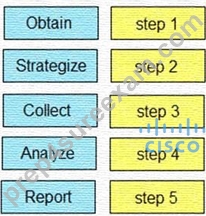
Answer:
Explanation: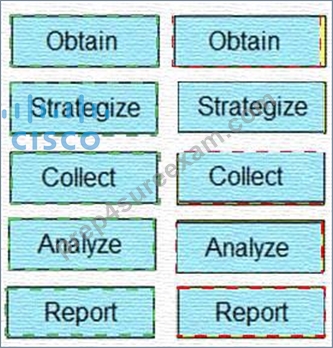
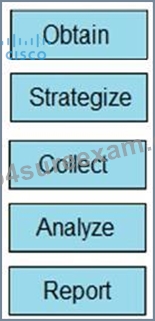
Reference: https://subscription.packtpub.com/book/networking_and_servers/9781789344523/1/ ch01lvl1sec12
/network-forensics-investigation-methodology
NEW QUESTION # 16 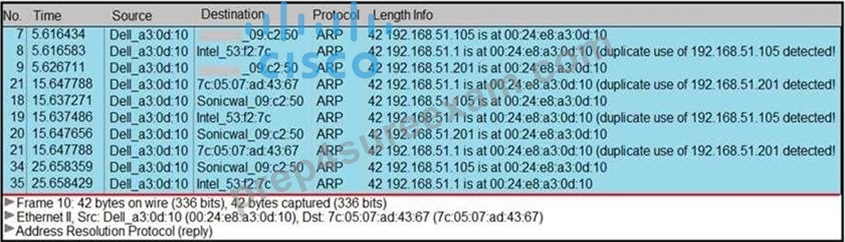
Refer to the exhibit. A security analyst notices unusual connections while monitoring traffic. What is the attack vector, and which action should be taken to prevent this type of event?
- A. SYN flooding, block malicious packets
- B. MAC flooding; assign static entries
- C. DNS spoofing; encrypt communication protocols
- D. ARP spoofing; configure port security
Answer: D
NEW QUESTION # 17
Refer to the exhibit.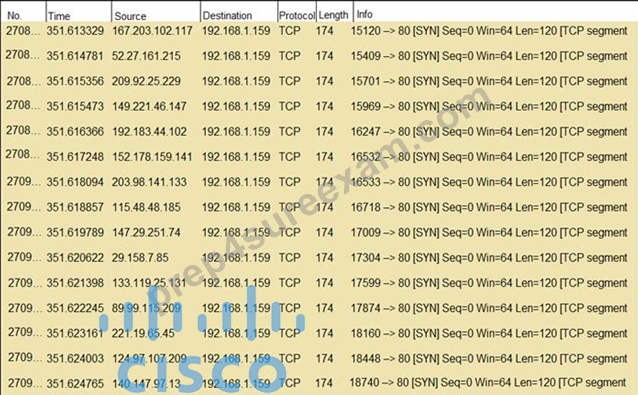
What should an engineer determine from this Wireshark capture of suspicious network traffic?
- A. There are signs of ARP spoofing, and the engineer should use Static ARP entries and IP address-to- MAC address mappings as a countermeasure.
- B. There are signs of a DNS attack, and the engineer should hide the BIND version and restrict zone transfers as a countermeasure.
- C. There are signs of SYN flood attack, and the engineer should increase the backlog and recycle the oldest half-open TCP connections.
- D. There are signs of a malformed packet attack, and the engineer should limit the packet size and set a threshold of bytes as a countermeasure.
Answer: C
Explanation:
In the provided Wireshark capture, we see multiple TCP SYN packets being sent from different source IP addresses to the same destination IP address(192.168.1.159:80)within a short time window. These SYN packets do not show a corresponding SYN-ACK or ACK response, indicating that these TCP connection requests are not being completed.
This pattern is indicative of aSYN flood attack, a type of Denial of Service (DoS) attack. In this attack, a malicious actor floods the target system with a high volume of TCP SYN requests, leaving the target's TCP connection queue (backlog) filled with half-open connections. This can exhaust system resources, causing legitimate connection requests to be denied or delayed.
Thecountermeasurefor this scenario, as highlighted in theCyberOps Technologies (CBRFIR) 300-215 study guideunderNetwork-Based Attacks and TCP SYN Flood Attacks, involves:
* Increasing the backlog queue: This allows the server to hold more half-open connections.
* Recycling the oldest half-open connections: This ensures that legitimate connections have a chance to be established if the backlog fills up.
Reference:CyberOps Technologies (CBRFIR) 300-215 study guide, Chapter 5: Identifying Attack Methods, SYN Flood Attack section, page 146-148.
NEW QUESTION # 18 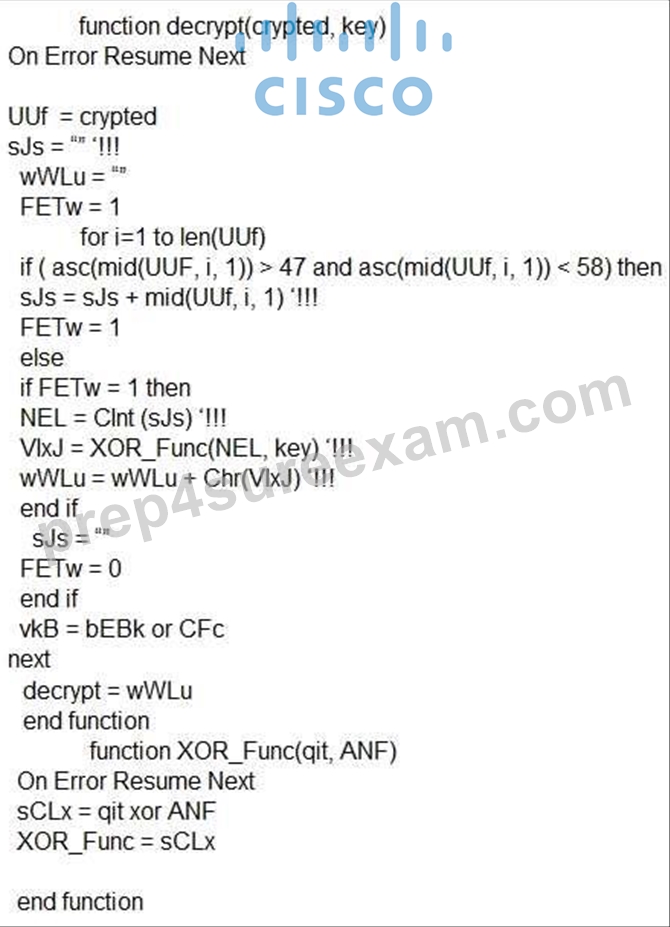
Refer to the exhibit. Which type of code created the snippet?
- A. Python
- B. PowerShell
- C. Bash Script
- D. VB Script
Answer: D
Explanation:
Explanation/Reference:
NEW QUESTION # 19
What is the transmogrify anti-forensics technique?
- A. changing the file header of a malicious file to another file type
- B. hiding a section of a malicious file in unused areas of a file
- C. sending malicious files over a public network by encapsulation
- D. concealing malicious files in ordinary or unsuspecting places
Answer: A
Explanation:
Reference:
https://www.csoonline.com/article/2122329/the-rise-of-anti-forensics.html#:~:text=Transmogrify%20is% 20similarly%20wise%20to,a%20file%20from%2C%20say%2C%20.
NEW QUESTION # 20
An analyst finds .xyz files of unknown origin that are large and undetected by antivirus. What action should be taken next?
- A. Move the files to a less secure network segment for analysis.
- B. Delete the files immediately to prevent potential risks.
- C. Rename the file extensions to .txt to enable easier opening and review by team members.
- D. Isolate the files and perform a deeper heuristic analysis to detect potential unknown malware or data exfiltration payloads.
Answer: D
Explanation:
The safest and most effective approach is to isolate the files and subject them to heuristic and behavioral analysis. This can reveal obfuscated malware or unauthorized data storage techniques, even if signature-based antivirus fails to flag them.
NEW QUESTION # 21
Refer to the exhibit.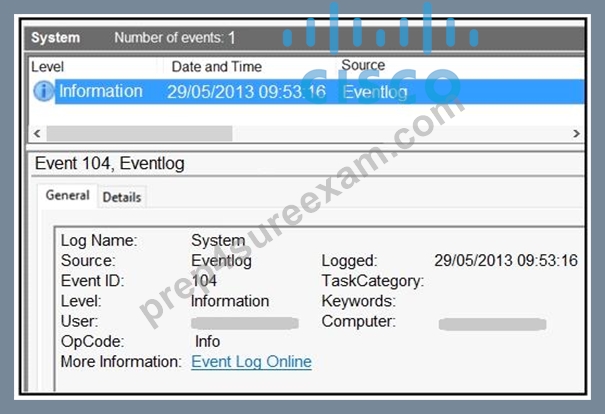
An employee notices unexpected changes and setting modifications on their workstation and creates an incident ticket. A support specialist checks processes and services but does not identify anything suspicious. The ticket was escalated to an analyst who reviewed this event log and also discovered that the workstation had multiple large data dumps on network shares. What should be determined from this information?
- A. brute-force attack
- B. data obfuscation
- C. log tampering
- D. reconnaissance attack
Answer: D
NEW QUESTION # 22
Refer to the exhibit.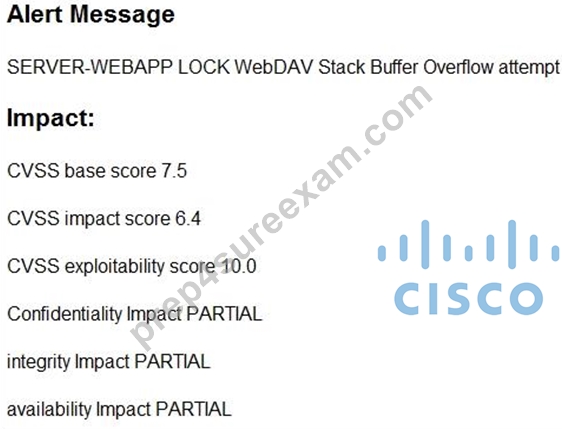
After a cyber attack, an engineer is analyzing an alert that was missed on the intrusion detection system. The attack exploited a vulnerability in a business-critical, web-based application and violated its availability.
Which two mitigation techniques should the engineer recommend? (Choose two.)
- A. address space randomization
- B. encapsulation
- C. heap-based security
- D. NOP sled technique
- E. data execution prevention
Answer: A,E
Explanation:
The alert indicates aWebDAV Stack Buffer Overflow, which is amemory corruptionattack targeting the stack, a common vector forremote code executionordenial-of-service (DoS).
To mitigate such exploits, two effective system-hardening techniques are:
* C. Address Space Layout Randomization (ASLR):Randomizes memory addresses used by system and application processes, making it difficult for attackers to predict where their malicious code will be executed.
* E. Data Execution Prevention (DEP):Prevents execution of code from non-executable memory regions such as the stack, thus stopping buffer overflow attacks from successfully executing payloads.
Both are well-established protections against stack-based buffer overflow attacks and are strongly recommended in the Cisco CyberOps Associate guide and general security best practices.
NEW QUESTION # 23
An engineer is investigating a ticket from the accounting department in which a user discovered an unexpected application on their workstation. Several alerts are seen from the intrusion detection system of unknown outgoing internet traffic from this workstation. The engineer also notices a degraded processing capability, which complicates the analysis process. Which two actions should the engineer take? (Choose two.)
- A. Replace the faulty CPU.
- B. Disconnect from the network.
- C. Restore to a system recovery point.
- D. Format the workstation drives.
- E. Take an image of the workstation.
Answer: B,E
Explanation:
When suspicious activity is detected on a workstation, immediate steps need to be taken to preserve evidence and prevent further compromise:
* Disconnecting the system from the network (C)is crucial to stop potential exfiltration of data or ongoing communications with a command-and-control server. This isolation prevents further spread or damage while preserving the state of the compromised system for further investigation.
* Taking an image of the workstation (E)is part of the forensics acquisition process. It involves creating a bit-by-bit copy of the system's disk, which preserves all evidence in its current state. This allows for thorough forensic analysis without affecting the original evidence.
These steps align with the best practices outlined in the incident response and forensics processes (as described in theCyberOps Technologies (CBRFIR) 300-215 study guide). Specifically, in theIdentification and Containmentphases of the incident response cycle, it's emphasized that isolating the system and preserving evidence through imaging are critical to ensuring both containment of the threat and successful forensic investigation.
Reference:CyberOps Technologies (CBRFIR) 300-215 study guide, Chapter: Understanding the Security Incident Response Process, Identification and Containment Phases, page 102-104.
NEW QUESTION # 24
A security team receives reports of multiple files causing suspicious activity on users' workstations. The file attempted to access highly confidential information in a centralized file server. Which two actions should be taken by a security analyst to evaluate the file in a sandbox? (Choose two.)
- A. Inspect processes.
- B. Inspect registry entries
- C. Inspect file type.
- D. Inspect file hash.
- E. Inspect PE header.
Answer: A,D
NEW QUESTION # 25
Refer to the exhibit.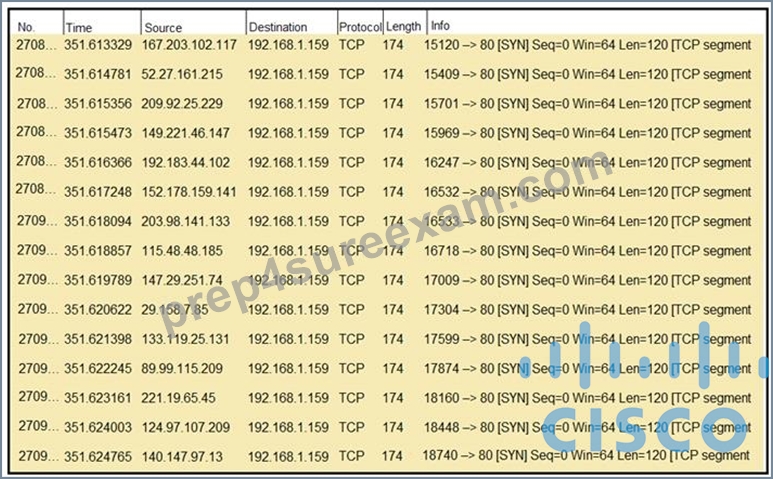
What should an engineer determine from this Wireshark capture of suspicious network traffic?
- A. There are signs of a DNS attack, and the engineer should hide the BIND version and restrict zone transfers as a countermeasure.
- B. There are signs of SYN flood attack, and the engineer should increase the backlog and recycle the oldest half-open TCP connections.
- C. There are signs of a malformed packet attack, and the engineer should limit the packet size and set a threshold of bytes as a countermeasure.
- D. There are signs of ARP spoofing, and the engineer should use Static ARP entries and IP address-to-MAC address mappings as a countermeasure.
Answer: B
NEW QUESTION # 26
An employee receives an email from a "trusted" person containing a hyperlink that is malvertising. The employee clicks the link and the malware downloads. An information analyst observes an alert at the SIEM and engages the cybersecurity team to conduct an analysis of this incident in accordance with the incident response plan. Which event detail should be included in this root cause analysis?
- A. phishing email sent to the victim
- B. alert identified by the cybersecurity team
- C. information from the email header
- D. alarm raised by the SIEM
Answer: A
Explanation:
Theroot cause analysisin incident response focuses on identifying theinitial trigger or root causeof the incident to understand how it started and how to prevent recurrence. In this scenario, thephishing email sent to the victim(A) is the initial trigger that led to the employee's action of clicking the malvertising link, resulting in the malware download.
The other options represent later stages in the incident response cycle, such as detection (SIEM alert, cybersecurity team's alert) or supporting evidence (email header information), but they do not address the root cause, which is thephishing email itself.
This aligns with theCyberOps Technologies (CBRFIR) 300-215 study guide, which states that identifying theinitial vector of compromiseis critical to theroot cause analysisphase of incident response (Chapter:
Incident Response Techniques, page 410-412).
Reference:CyberOps Technologies (CBRFIR) 300-215 study guide, Chapter: Incident Response Techniques, Root Cause Analysis, page 410-412.
NEW QUESTION # 27
Which tool conducts memory analysis?
- A. Memoryze
- B. MemDump
- C. Sysinternals Autoruns
- D. Volatility
Answer: D
NEW QUESTION # 28
A cybersecurity analyst detects fileless malware activity on secure endpoints. What should be done next?
- A. Immediately quarantine the endpoints containing the suspicious files and consider the issue resolved
- B. Delete the suspicious files and monitor the endpoints for any further signs of compromise.
- C. Isolate the affected endpoints and conduct a detailed memory analysis to identify fileless malware execution.
- D. Share the findings with other government agencies for collaborative threat analysis and response.
Answer: C
Explanation:
Fileless malware resides in memory and does not leave traditional file artifacts, making it difficult for antivirus solutions to detect. The most effective next step is to isolate the endpoints to prevent lateral movement and perform memory forensics to capture volatile data and identify any running malicious processes.
NEW QUESTION # 29
A security team needs to prevent a remote code execution vulnerability. The vulnerability can be exploited only by sending '${ string in the HTTP request. WAF rule is blocking '${', but system engineers detect that attackers are executing commands on the host anyway. Which action should the security team recommend?
- A. Add two WAF rules to block 'S' and '{' characters separately.
- B. Block incoming web traffic.
- C. Enable URL decoding on WAF.
- D. Deploy antimalware solution.
Answer: C
Explanation:
When Web Application Firewalls (WAFs) are configured to block specific patterns (like${), attackers may bypass this using URL encoding (e.g.,%24%7B). In such cases, the WAF must decode these patterns before applying matching rules. EnablingURL decodingensures the WAF recognizes encoded payloads and applies protections appropriately. This is a recommended hardening strategy against bypass techniques for command injection and remote code execution.
Reference: Cisco CyberOps v1.2 Guide, Chapter on WAFs and Input Validation Techniques.
-
NEW QUESTION # 30
An investigator is analyzing an attack in which malicious files were loaded on the network and were undetected. Several of the images received during the attack include repetitive patterns. Which anti-forensic technique was used?
- A. obfuscation
- B. steganography
- C. tunneling
- D. spoofing
Answer: B
Explanation:
The use of repetitive patterns in images is a known indicator of steganography, which is an anti-forensics technique used to hide malicious code or files inside seemingly benign content such as image or audio files.
The repetitive patterns suggest that the image may contain embedded hidden data. This technique is particularly difficult to detect through conventional scanning or antivirus software.
According to theCyberOps Technologies (CBRFIR) 300-215 study guide, steganography is defined as
"concealing malicious content or instructions within ordinary files such as .jpg, .png, or audio files, allowing the content to bypass security filters and reach the target system without detection".
-
NEW QUESTION # 31
An organization uses a Windows 7 workstation for access tracking in one of their physical data centers on which a guard documents entrance/exit activities of all personnel. A server shut down unexpectedly in this data center, and a security specialist is analyzing the case. Initial checks show that the previous two days of entrance/exit logs are missing, and the guard is confident that the logs were entered on the workstation. Where should the security specialist look next to continue investigating this case?
- A. HKEY_LOCAL_MACHINES\SOFTWARE\Microsoft\WindowsNT\CurrentUser
- B. HKEY_LOCAL_MACHINE\SOFTWARE\Microsoft\WindowsNT\CurrentVersion\ProfileList
- C. HKEY_LOCAL_MACHINE\SOFTWARE\Microsoft\WindowsNT\CurrentVersion\Winlogon
- D. HKEY_CURRENT_USER\Software\Classes\Winlog
Answer: B
Explanation:
The correct registry path to investigate user profiles and login details is:
HKEY_LOCAL_MACHINE\SOFTWARE\Microsoft\WindowsNT\CurrentVersion\ProfileList This location stores information about each user profile on the machine, including login activity and the LastWrite time for forensic tracking.
NEW QUESTION # 32
What is the steganography anti-forensics technique?
- A. hiding a section of a malicious file in unused areas of a file
- B. sending malicious files over a public network by encapsulation
- C. concealing malicious files in ordinary or unsuspecting places
- D. changing the file header of a malicious file to another file type
Answer: C
Explanation:
Steganography is the anti-forensics technique of hiding malicious content within seemingly innocent files, such as image, audio, or video files. The goal is to conceal data or code in a way that avoids suspicion and detection, thereby making traditional security inspection tools ineffective unless they are explicitly designed to detect hidden data within media files.
Steganography differs from encryption because it does not simply make data unreadable; it hides the existence of the data itself. It is commonly used in cyber operations to hide command-and-control instructions or to exfiltrate sensitive information in covert ways.
Reference:CyberOps Technologies (CBRFIR) 300-215 study guide, Chapter on Evasion and Obfuscation Techniques, Anti-Forensics, Steganography Section.
NEW QUESTION # 33
Which tool is used for reverse engineering malware?
- A. Ghidra
- B. NMAP
- C. SNORT
- D. Wireshark
Answer: A
NEW QUESTION # 34
......
The benefit in Obtaining the Conducting Forensic Analysis and Incident Response Using Cisco CyberOps Technologies (CBRFIR)
Traditional information security is no match for the expanding cybercrime ecosystem; therefore, security measures must evolve to intelligent security rather than information security. Achieving the Cisco Certified CyberOps Professional certification elevates your skills to meet that demand and confirms your abilities as an Information Security analyst in incident response roles, cloud security, and other active defense security roles.
Other benefits of the exam are:
- After completing the Cisco Certified Network Professional Security certification Candidate becomes a solid, well-rounded network engineer.
- When an organization hiring or promotion an employee, then the decision is made by human resources. Now while Candidate may have an IT background, they do their decisions in a way that takes into record many different factors. One thing is candidates have formal credentials, such as the Cisco Certified Network Professional Security.
- If the Candidate has the desire to move up to a higher-paying position in an organization. This certification will help as always.
- A candidate might have incredible IT skills. Employers that do the hiring need to make decisions based on limited information and as it always. When they view the official Cisco Certified Network Professional Security certification, they can be guaranteed that a candidate has achieved a certain level of competence.
Updated Cisco Study Guide 300-215 Dumps Questions: https://lead2pass.prep4sureexam.com/300-215-dumps-torrent.html