


Authoritative learning platform
SEND guide torrent is authoritative. Over the years, our study materials have helped tens of thousands of candidates successfully pass the exam. SEND certification training is prepared by industry experts based on years of research on the syllabus. These experts are certificate holders who have already passed the certification. They have a keen sense of smell for the test. Therefore, SEND certification training is the closest material to the real exam questions. With our study materials, you don't have to worry about learning materials that don't match the exam content. With Endocrinology and Diabetes (Specialty Certificate Examination) study guide, you only need to spend 20 to 30 hours practicing to take the exam. In addition, SEND certification training has a dedicated expert who updates all data content on a daily basis and sends the updated content to the customer at the first time. Therefore, using SEND guide torrent, you don't need to worry about missing any exam focus.
When you decide to prepare for the SEND certification, you must want to pass at first attempt. Now, make a risk-free investment in training and certification with the help of SEND practice torrent. Our SEND test engine allows you to practice until you think it is ok. Our Endocrinology and Diabetes (Specialty Certificate Examination) study guide is the best relevant and can hit the actual test, which lead you successfully pass. SEND guide torrent uses a very simple and understandable language, to ensure that all people can read and understand.

100% pass rate guarantee
It is our mission to help you pass the exam. SEND guide torrent will provide you with 100% assurance of passing the professional qualification exam. We are very confident in the quality of Endocrinology and Diabetes (Specialty Certificate Examination) study guide. And we believe that all students who have purchased our study materials will be able to successfully pass the professional qualification exam as long as they follow the content provided by SEND study guide, study it on a daily basis, and conduct regular self-examination through mock exams. Once you unfortunately fail the exam, SEND guide torrent will provide you with a full refund and the refund process is very simple. As long as you provide your staff with your transcripts, you will receive a refund soon. Of course, before you buy, SEND certification training offers you a free trial service, as long as you log on our website, you can download our trial questions bank for free. I believe that after you try SEND certification training, you will love them.
Comprehensive and easy to understand contents
Are you still feeling distressed for expensive learning materials? Are you still struggling with complicated and difficult explanations in textbooks? Do you still hesitate in numerous tutorial materials? Endocrinology and Diabetes (Specialty Certificate Examination) study guide can help you to solve all these questions. SEND certification training is compiled by many experts over many years according to the examination outline of the calendar year and industry trends. SEND study guide not only apply to students, but also apply to office workers; not only apply to veterans in the workplace, but also apply to newly recruited newcomers.
MRCPUK SEND Exam Syllabus Topics:
| Section | Weight | Objectives |
|---|---|---|
| Topic 1: Reproductive and Other Endocrine Conditions | 15% | - Disorders of puberty and sex development - Obesity and lipid disorders - Polycystic ovary syndrome - Endocrine hypertension and rare syndromes |
| Topic 2: Thyroid Disorders | 15% | - Hypothyroidism and myxoedema coma - Thyroiditis and subclinical dysfunction - Thyroid nodules and cancer - Hyperthyroidism: Graves’ disease, toxic nodular disease |
| Topic 3: Pituitary and Hypothalamic Disorders | 15% | - Hypopituitarism and hormone replacement - Hypothalamic dysfunction - Diabetes insipidus and SIADH - Pituitary adenomas: prolactinoma, acromegaly, Cushing's disease |
| Topic 4: Diabetes Mellitus | 40% | - Other forms of diabetes
|
| Topic 5: Adrenal and Parathyroid/Metabolic Bone Disorders | 15% | - Primary/secondary hyperaldosteronism - Hyperparathyroidism, hypoparathyroidism - Osteoporosis, osteomalacia, Paget's disease - Cushing's syndrome, Addison's disease, phaeochromocytoma |
MRCPUK Endocrinology and Diabetes (Specialty Certificate Examination) Sample Questions:
1. A 26-year-old woman was recovering from diabetic ketoacidosis and had been switched to her usual basal bolus insulin regimen. Her capillary blood glucose measurements during the day were high but fasting plasma glucose was in the range 5.0-7.0 mmol/L (3.0-6.0). She was drinking and eating normally.
On examination, her pulse was 76 beats per minute and her blood pressure was 106/66 mmHg. Urinalysis showed ketones 1+.
Investigations:
serum sodium143 mmol/L (137-144)
serum potassium4.4 mmol/L (3.5-4.9)
serum bicarbonate22 mmol/L (20-28)
serum creatinine72 umol/L (60-110)
plasma glucose 2 h after breakfast21 mmol/L
What is the most appropriate next step in management?
A) start variable-rate intravenous insulin infusion
B) start glucose 5% with intravenous insulin
C) increase basal insulin at bed time
D) change to twice daily pre-mixed insulin
E) increase bolus insulin with meal
2. A 24-year-old woman was referred with an 18-month history of worsening hirsutism, primarily on her face, but also new hair growth on her chest. She was shaving weekly. She had always been overweight, but had recently gained 5 kg and her body mass index was 31 kg/m2 (18-25). Her periods were regular.
What is the most relevant next investigation?
A) plasma thyroid-stimulating hormone
B) serum testosterone
C) serum dehydroepiandrosterone
D) serum 17-hydroxyprogesterone
E) overnight dexamethasone suppression test (after 1 mg dexamethasone)
3. A 25-year-old man presented with a 2-month history of thirst and polyuria. He had minimal weight loss and his body mass index was 26 kg/m2 (18-25). He had had sensorineural deafness since childhood. There was a very strong family history of sensorineural deafness and type 2 diabetes mellitus.
Urinalysis showed no ketones.
Investigations:
random plasma glucose18.0 mmol/L
What is the most appropriate next step in management?
A) genetic testing for maturity-onset diabetes of the young
B) test for HFE genotype
C) test for mitochondrial diabetes
D) measurement of glutamic acid decarboxylase antibodies
E) water deprivation test to assess posterior pituitary function
4. A 56-year-old man presented with a 6-month history of erectile dysfunction. He had noticed a gradual reduction in his frequency of shaving from daily to twice a week. His libido had diminished and he felt that he was not as strong as he once was. He also described general aches and pains. He was a farm worker and had drunk a bottle of vodka daily for several years, but had stopped drinking 2 years previously. He was a non-smoker.
Investigations:
serum urea6.2 mmol/L (2.5-7.0)
serum creatinine89 umol/L (60-110)
serum albumin40 g/L (37-49)
serum total bilirubin17 umol/L (1-22) serum alanine aminotransferase48 U/L (5-35) serum aspartate aminotransferase37 U/L (1-31) haemoglobin A1c55 mmol/mol (20-42)
serum cortisol (09.00 h)389 nmol/L (200-700) serum testosterone0.7 nmol/L (9.0-35.0) plasma follicle-stimulating hormone2.1 U/L (1.0-7.0) plasma luteinising hormone2.4 U/L (1.0-10.0) serum prolactin458 mU/L (<360) serum thyroid-stimulating hormone3.4 mU/L (0.4-5.0)
MR scan of pituitarysee image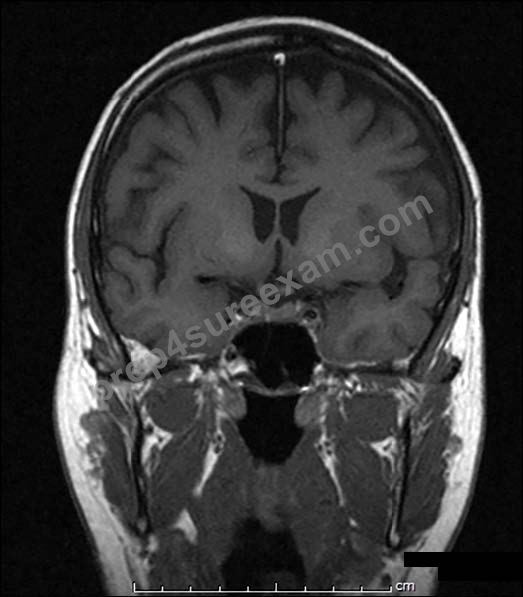
What is the most likely explanation of his symptoms?
A) hyperprolactinaemia
B) pituitary adenoma
C) age-related hypogonadism
D) cirrhosis of liver
E) haemochromatosis
5. A 48-year-old man presented with an infected ulcer, measuring 2 ? 1 cm, over the right first metatarsal head, with surrounding cellulitis. He had no previous history of diabetes mellitus but had been told by his general practitioner some years previously that his blood glucose was 'borderline'.
On examination, his temperature was 37.4C, his blood pressure was 158/92 mmHg and his body mass index was 31.5 kg/m2 (18-25). His foot pulses were easily palpable but he had a sensory neuropathy.
Investigations:
random plasma glucose16.4 mmol/L
haemoglobin A1c81 mmol/mol (20-42)
What is the most appropriate treatment for his hyperglycaemia?
A) gliclazide 40 mg twice daily
B) exenatide 5 micrograms twice daily
C) soluble insulin before meals, basal insulin at bedtime
D) metformin 500 mg twice daily
E) sitagliptin 100 mg once daily
Solutions:
| Question # 1 Answer: E | Question # 2 Answer: B | Question # 3 Answer: C | Question # 4 Answer: E | Question # 5 Answer: D |

No help, Full refund!
Prep4sureExam confidently stands behind all its offerings by giving Unconditional "No help, Full refund" Guarantee. Since the time our operations started we have never seen people report failure in the exam after using our SEND exam braindumps. With this feedback we can assure you of the benefits that you will get from our SEND exam question and answer and the high probability of clearing the SEND exam.
We still understand the effort, time, and money you will invest in preparing for your MRCPUK certification SEND exam, which makes failure in the exam really painful and disappointing. Although we cannot reduce your pain and disappointment but we can certainly share with you the financial loss.
This means that if due to any reason you are not able to pass the SEND actual exam even after using our product, we will reimburse the full amount you spent on our products. you just need to mail us your score report along with your account information to address listed below within 7 days after your unqualified certificate came out.
 Atwood
 Cecil
Cecil  Paula
Paula 
 Meredith
  Humphrey
 Harley
  Iris
Iris  Cathy
Cathy  Agnes
Agnes  Beatrice
  Pete
Pete  Ronald
  Emma
Emma 


